
The Last Shift
Marie Anne Arreola
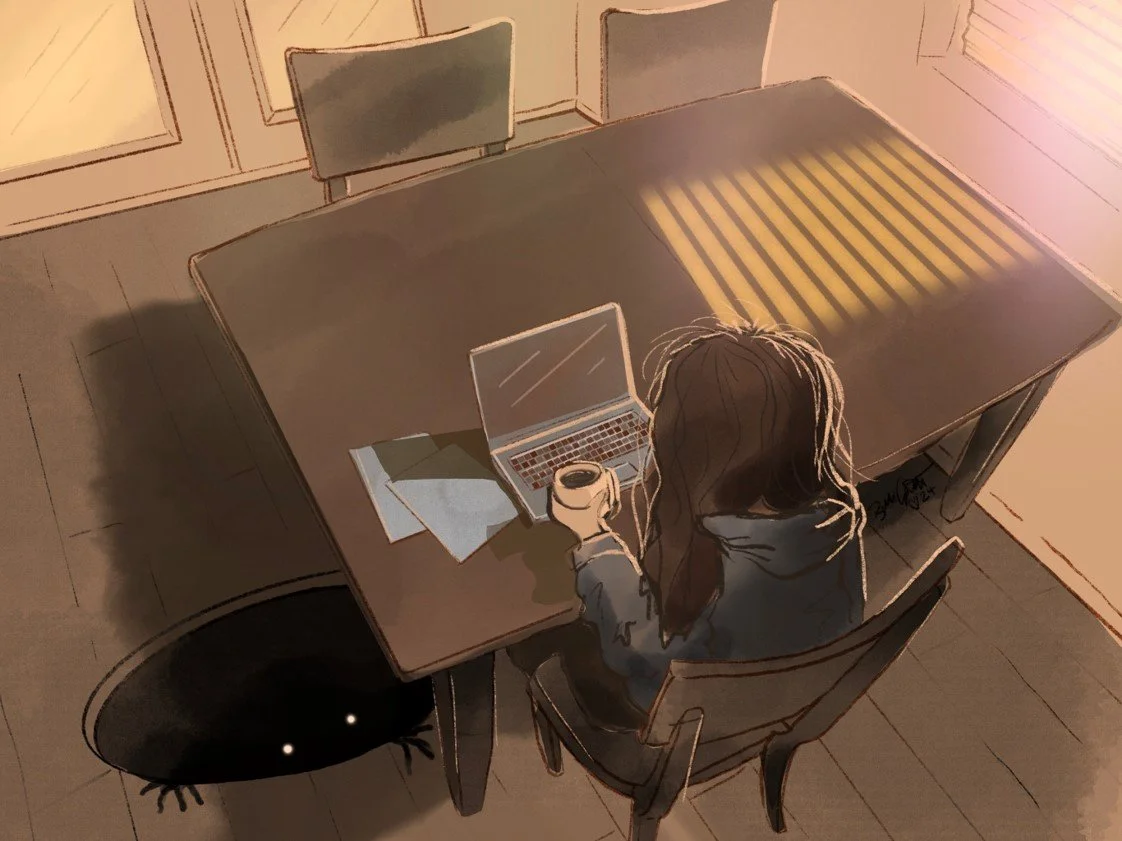
Brooke Marcélle Carpenter, Panic Disorder 1, 2024. Digital, 8” x 11”
I had an idea (dangerous, industrial) one morning just before five, when the city was still quiet and the birds were still negotiations. The idea was this: I would treat my art like a job. Not a calling, not a bleeding, not a spiritual awakening—but a job. A shift to clock in and out of. A system of labor with coffee breaks, performance reviews, and KPIs.
I would become the CEO of my output. It wasn’t just an idea, though. It was a surrender. An unspoken pact with fatigue.
I was tired of the myth of genius, of waiting for lightning while standing in the rain with a fork. I wanted shelter. A ledger. Some hard proof I was doing something with my life. If I couldn’t believe in miracles, I could at least believe in productivity. So I rose with the gods of disruption. Walked before dawn like Jobs. Did push-ups like Sheryl. I put on trousers. A blazer, sometimes. Lip balm with intention. I said good morning to no one in particular and sat at my desk like a woman preparing to fire someone, even if the someone was me.
It wasn’t a persona. It was the industrialization of feeling. I thought maybe if I just treated it like any other career, I’d finally make something that looked like art. Something that didn’t unravel when looked at too long. Something that earned its keep.
*
I bought a coffeemaker that made the kind of noise espresso machines do in films about divorce. I bought an ergonomic chair—lumbar support for emotional instability. I broke my days into 15-minute blocks. "Time to be human." “Time for creative output.” “Time for a sandwich.” “Time to let grief know it’s not on today’s agenda.”
Even grief, I figured, needed boundaries.
Even grief needed a swipe card.
*
I typed long, breathless confessions into the notes section of Google Calendar events. I rescheduled my emotions for Q3. I tried to time my breakdowns between client calls.
Once, I sobbed quietly while writing a newsletter about resilience for a company that sold flavored protein powders. Once, I cried in a coworking space bathroom stall because the world had too many fonts. Eventually, I had another idea: maybe the whole thing needed to fall apart.
So I closed some doors. Real ones, symbolic ones. I ghosted upward mobility.
I quit the dream jobs I never wanted and applied to ones I’d never take, just to feel the pleasure of saying no. I wanted an offer from Amazon like a test of character. I tidied my website. Upgraded to LinkedIn Premium. I posted about resilience and waited for the algorithm to teach me about grace. It didn’t. But I did learn how to market disappointment.
*
When the days grew elastic and the hours began to echo, I filled them with sentences. I wrote because I had too much time to think, and thinking too long about anything is a dangerous sport. The mind, left unattended, starts inventing corridors. So I walked down one and found a story waiting there, patient as dust. Maybe that’s all fiction is: some inescapable friction, or a fraction of living rearranged to look whole. What’s funny about being a novelist is how stupid one becomes, really. You grow less articulate the more words you accrue. The longer I spent in pursuit of some luminous artistic vision, the more it all sounded like babble—flashes of insight embedded in flurries of exhaustion. My thoughts were as soft and useless as wilted celery. But still I wrote them down. I didn’t know what else to do with my hands.
It started with my friends. Catch-ups that became landmines. They asked how I was, and I wanted to say anything but the truth. I was tired of being the bearer of persistent melancholy. Of repackaging the same old sadness like stale holiday leftovers. I imagined they must be exhausted of me, but the truth was I was just exhausted of myself. You cannot recycle grief indefinitely. The feeling itself begins to dull.
On the inside, I was a factory line of sorrow. On the outside, I was just a person, a person with aching feet and a resume gap. Nothing tragic. Just tedious. The worst part was the temporariness of it all. That I wouldn’t live with my parents forever. That I wouldn’t be broke or in pain or lonely forever. It was a season, not a sentence. And that, somehow, made it worse. The temporary felt like mockery.
One afternoon, I caught one of those slow buses, the fluorescent ones that smell like metal and rain. I didn’t have anywhere to go; I just wanted motion. The city passed in fragments: a vape shop opening late, a teenager skateboarding against traffic, a man selling pirated DVDs out of a gym bag. My reflection in the window looked like someone else’s life on pause. The driver muttered into his headset. I watched it all blur and thought, maybe this is enough, to just witness, to move without meaning. Eventually, I did what the internet and my therapist and my grandmother all advised: I accepted it. I stopped trying to alchemize my pain into something meaningful. I let it just … be. Something about letting go of the transformation made it easier to breathe. I found that distraction wasn’t a sin—it was a way through.
So I started looking for that again: a conversation with a stranger, a mediocre documentary about something vast and unfixable. Little reminders that the world keeps running, even when you’ve stepped off the clock.
I rediscovered that days are built from minutes. And most minutes are survivable.
Pain, when ignored, becomes mythic. But once named, it shrinks.
What I hadn’t realized was this: my finished work, the polished, presentable thing, would betray me. It would expose the quiet architecture of loss beneath every sentence. That to be human is to be in a constant state of subtraction, of letting go of selves, cities, summers, sweetness. The strawberries that never quite ripen. The malls that play piano songs your father half-remembered. The missing is not nostalgia—it’s muscle memory.
And yet I keep missing. I miss wanting. I miss the teeth of peach flesh. I miss turning my lungs inside out for a kiss. I kiss a box of berries into the yard and hope they come back curious. I miss myself into silence. Into song. Into metaphors that fold in on themselves like linens that will never smell clean again. Emily Dickinson called. She says you can keep the bedroom, but don’t forget to open the window. Morning still arrives whether you’re ready or not.
I once thought writing was about finding truth, but now I see it’s about bearing witness to the lie of precision. Consciousness isn’t clear. It’s a secondhand screen grab of dreams. And I’m just here trying to find sounds I like, pressing record on this barely-contained spirit world we call a body.
*
Sometimes I want writing to save people. To pluck them from the edge of death, not literally, but spiritually. I want my words to make the unbearable a little more breathable. To conjure a future someone might choose to step into. A softer, stranger possibility.
I don’t know if that’s possible. But I know it’s worth trying.
The knot, they say, is not of the string. It’s the closeness between strands. The tension. The refusal to unravel. And when you learn—through ruin, through grace—to find the edges and gently loosen, you discover it never really existed.
The knot was just the name we gave to our fear of letting go.
I may not know what holds a life together. But I know what loosens it: beauty, absurdity, pink carpeted department stores. Obsolete malls. A minor chord. The edge of a sentence.
The tenderness of wanting something you can’t keep.
That’s the job.
Marie Anne Arreola is a cultural journalist, editor, and writer from Sonora, Mexico. She is the founder and editor-in-chief of PROYECTO VOCES, a digital magazine amplifying emerging voices in art, literature, music, and design. Her work, appearing in outlets such as Latina Media Co., Hypermedia Magazine, and Lucky Jefferson, explores identity, memory, and grassroots cultural practices. Author of the debut novel Sparks of the Liberating Spirit Who Trapped Us Back in Woodstock (Foreshore Publishing, UK, 2025), she writes across journalism, poetry, and hybrid forms to foster inclusive, transnational conversations.