
Interview: Catherine Broadwall
By Hannah Opp

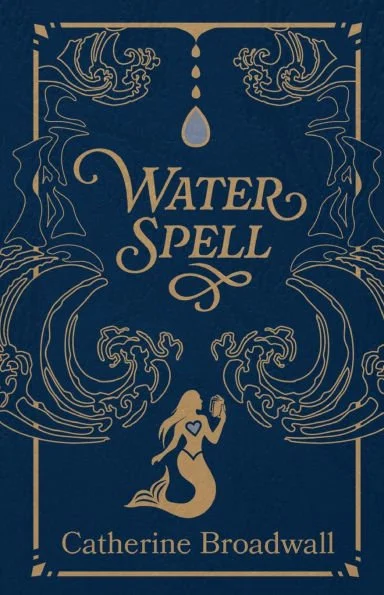
In her memoir, Water Spell, Catherine Broadwall balances the devastation of the past with the joy of the future as she tells the story of how she was able to rebuild and rediscover herself following the end of her marriage. Primarily comprised of short flash essays, this is a quick, hopeful read that weaves in references to a variety of artistic media through the use of a literary device called ekphrasis. Nearly every chapter draws inspiration from a specific comic, anime, fairy tale, or sci-fi universe to help draw parallels and create pathways into Broadwall’s interior world during this difficult time.
I interviewed Broadwall to further explore her approach to writing Water Spell and the impact she hoped her memoir would have on her readers.
Hannah Opp: Despite discussing what was clearly a painful and messy ordeal, you wrote with quite a bit of grace and seemingly chose to focus on the emotions more so than the events, even going so far as to anonymize your ex as "the man of mist" and shroud certain events. Tell me a bit about how you decided to approach telling this story and your reasoning behind these choices.
Catherine Broadwall: My goal is for this book to help people. For years, I’ve admired Toni Morrison’s advice that if you’re looking for a certain kind of book and not finding it, you might be the person who has to write it. A lot happened to me in 2021: I applied for a job back in my home state, where I’d wanted to return for years, and got it. I had a marriage abruptly end, with the job application being a significant catalyst. Upon moving back home, I reunited with a lost love for whom I’d never stopped having feelings. I didn’t expect to have that kind of year, but as a writer, I knew two things: (1) that I wanted to “take notes” on what I was experiencing so I could learn from it, and (2) that maybe, by telling the story of how I survived and navigated all these changes, I could help someone else.
I mention 2021 because there was, at that time, a phenomenon called the Great Resignation going on, where lots of people were leaving their jobs. There were many reasons for this, of course, but according to what I’ve read, one factor was that the COVID-19 pandemic sparked a kind of urgent self-reflection. People were asking themselves if their lives really satisfied them in the ways they wanted and making changes if necessary. That was true for me. In other words, I realized that I was part of a larger historical shift, so I wanted to write about my story both as a unique, personal one and as a microcosm of that trend. In that way, the “why” of Water Spell felt even more important than the “what.”
I also think it’s important to consider ethics when writing creative nonfiction. The only story I can tell is my own. For that reason, I wanted to keep the focus on my own thoughts, feelings, reactions, and decisions. As I mentioned, the goal of the book isn’t to cast anyone as a villain. Some details were shared in order to convey why emotions were running high, but I prioritized discernment and did my best to respect the line between my story and anyone else’s.
HO: Throughout the book, your ex and your current partner, "Cerulean," kind of serve as antitheses to one another. It's often said that joy is more difficult to write about than pain. Did you find that to be true as you began writing more about Cerulean? How did you overcome the challenges of each?
CB: I agree that joy is more difficult to write about than pain, and in fact, the book very deliberately questions why that might be. It’s something I’m still thinking about, and I don’t think there’s one single easy answer. I think pain is often more propulsive—something that writes with me, in a way—whereas happiness can feel quieter and as though I am writing to it rather than with it.
Writers are constantly advised to steer clear of sentimentality, which means there are some risks in writing about joy. But like I said, I wanted to question that common advice. The going wisdom seems to be that happiness is simple, while sadness is complex, and it’s part of a writer’s job to explore complexity. But if happiness were really that simple, we’d have world peace, right? So, more and more, I’m convinced that both are actually quite complex. I love exploring difficult emotions, but I’m interested in the nuance, variety, and texture of pleasant emotions too. That’s why I consciously made room for both in the book.
In terms of challenges, I think the two main tones of the book—alternatingly aching and grateful—complement each other, or at least that’s my hope. In my lived experience, the moments of goodness shone even brighter because of the larger context of pain. My attention was sharpened to everything, and that meant that I was paying extra close attention to grace, kindness, and connection as well as loss and fear.
HO: Did you make any surprising discoveries about or gain any new insight into joy while writing Water Spell?
CB: In a class I taught a few years ago, I assigned an excerpt of Ursula K. Le Guin’s article, “The Carrier Bag Theory of Fiction,” where she argues that not all stories have to include conquering or violence to be satisfying, as well as Roger Ebert’s interview with Hayao Miyazaki in which Miyazaki explains the concept of “ma”: intentional breaks in the action. Together, these led to a fascinating conversation where several students brought up the point that, in many action-adventure stories, it’s when the chips are truly down that a protagonist flashes back in their mind to a moment of stillness, happiness, or peace, and it’s the memory of that moment that unlocks some new ability or activates the epiphany needed to resolve the predicament they’re in. It could be as simple as giving them a burst of motivation because that moment of centering reminds them what they’re fighting for. I thought this was a wonderful insight. It’s true that without those moments of ease or enjoyment, action and drama can feel one-sided or even futile. I think about this a lot. We’re encouraged to strive, achieve, and grow ever stronger in our culture. And aiming high is great. But without keeping track of why we’re doing it—to connect with others in moments of joy—the struggle itself can become the whole point.
While this insight came about through discussions of fiction, I think it applies to life as well. It’s a goal of mine to cultivate and appreciate moments of intimacy and vibrance. If a struggle I’m engaged in is causing friction with that, I want to take a step back and reflect. I want to make sure I have a healthy balance in my life of pushing my own limits and taking moments of peace to breathe and appreciate all the goodness I have. Otherwise, I’d risk outrunning my own joy.
HO: When did you decide you wanted to structure the book using ekphrasis, and how did it guide your writing process? For example, did you find yourself collecting the artistic inspiration first, or did you discover it after trying to convey a particular emotion or scene?
CB: Prior to 2021, I had felt a desire to reflect on fictional characters from pop culture who had been formative in my youth. During my graduate studies, I focused a lot on young adult literature, and I was interested in the way that texts like those can get sort of dismissed or underestimated by our wider culture—treated like quick, forgettable entertainment rather than thought-provoking art. I have tremendous appreciation for classic works of literature, but I found that many of the texts that endured as sources of inspiration during hard times were those from pop culture: movies, video games, comics, and so on. So I’d had an urge to create a project that said, in effect, “Hey, this stuff can be meaningful too!” But the few attempts I’d made at writing in that vein—in particular, epistolary poems to various magical women from pop culture—felt like they lacked something vital.
When 2021 hit, that ghost of a form found its content. I often tell people I didn’t choose this book; this book chose me. I had a very clear sense that this was the occasion on which I could speak to the lasting power of these narratives in my life. It’s not an exaggeration to say that lessons imparted by Sailor Moon, Avatar: The Last Airbender, the Final Fantasy series, and so on saw me through some extremely difficult days. You might say it was a “back to basics” kind of year, where I had to reach for my most aspirational values in a time of unprecedented turbulence. From the start, it felt natural to reference images and scenes from pop culture because they emerged very organically as emotional compasses for me. They helped orient me toward the kind of person I wanted to be. It’s often said that crisis doesn’t build character, but rather reveals it, and I wanted what was revealed in me to be in line with qualities I admired in my childhood heroes.
HO: Was there any artistic inspiration that you wanted to use for an ekphrasis that didn't quite make it into the book or that you thought of afterward that you could share with us?
CB: You know, I somehow ended up watching Twilight for the first time in late 2021, and there may have been something to say there about the way romance and the loss of oneself can get tangled up. In 2022, my dad and I even went to the Hoh Rainforest in Olympic National Park, and when I realized we were less than an hour away from Forks (where Twilight is set), I asked if we could visit, and we saw a few tributes to the series around town, like Bella’s truck in front of the Chamber of Commerce. It was cool, but ultimately, I didn’t feel viscerally drawn to the source material enough to comment on it in the book. In the section called “Embrace,” though, you can find a bit of vampiric imagery, and I suppose that’s a nod to fact that I’d recently had that brush with the movie.
I also absolutely loved the character Waymond’s speech about kindness as a choice and a strategy for dealing with chaos in the movie Everything Everywhere All At Once, but by the time I saw it, I had touched on that core idea already through other ekphrastic pieces, and I didn’t want the book to feel repetitive. I resonated strongly with the ethic of that speech, though.
HO: Lastly, I want to circle back to the dedication you wrote for this book. "For anyone who has ever received guidance or hope from stories." What do you hope readers take away from Water Spell?
CB: One hope I have is that the book can help nudge the conversation forward around overly simplistic terms like “high” and “low” art. I’ve faced some skepticism and judgment over the years, particularly in academic spaces, about being a fan of sci-fi/fantasy, YA literature, works of animation, and video games. But all these things are just mediums and vehicles for storytelling. The work within them can be silly or thought-provoking or both, and it’s not my job to tell anyone else that a movie or book that made them a more empathetic person is something they should feel ashamed of just because it’s not in a canonically-standard format. If people have touchstones from fiction that remind them of their own capacity for resilience, compassion, growth, or other positive qualities that don’t involve harm to others, I’d say let them have them. It can be hard to find role models in real life, so if some are found in fiction, I think that’s okay.
Life can be hard, but stories can help see us through. I hope Water Spell offers one testament to that. I hope anyone reading it who may be working through difficult events will take heart and know they can get through the storm in one piece, and that joy might just be waiting on the other side. Outcomes are never guaranteed, of course, but if we conduct ourselves with integrity, I think that’s a reward unto itself. I can’t always control my circumstances, but I do have some say over my responses to them, and writing about that in Water Spell helped me remember that I have agency even in the most unwieldy of times. To anyone reading: you do, too.
Catherine Broadwall (formerly Catherine Kyle) is a poet and memoirist from the Pacific Northwest. She is the author of Aftermath (Girl Noise Press, forthcoming 2026), Water Spell (Cornerstone Press, 2025), Fulgurite (Cornerstone Press, 2023), Shelter in Place (Spuyten Duyvil, 2019), and other collections. Her writing has appeared in Bellingham Review, Colorado Review, Mid-American Review, and other journals. She was the winner of the 2023 Paula Svonkin Creative Arts Award and the 2020 COG Poetry Award, as well as a finalist for the poetry categories of the 2021 Mississippi Review Prize and 2021 Pinch Literary Awards. She holds an MFA from New England College and a Ph.D. from Western Michigan University.
Hannah Opp (she/her/hers) is a proud graduate of the University of Nebraska at Omaha where she studied Creative Nonfiction. She is a writer and editor whose recent work has appeared in Ars Medica and Dreamers Creative Writing.