
Interview: Andrea Carlisle
By Isabella Manhart
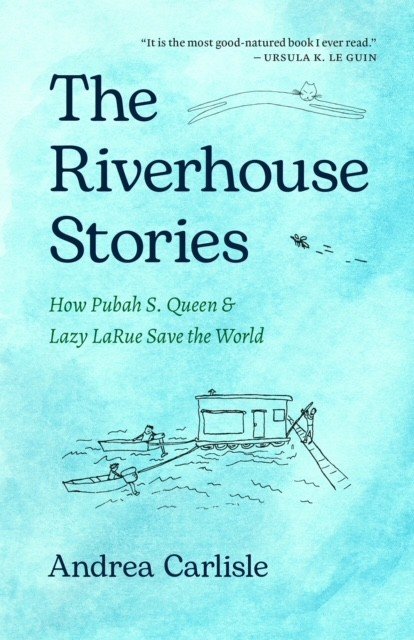
“Lazy loved Pubah and loved loving her. Out past the edges of the world’s agreement, beyond even her own standards, her own approval, the rules of her childhood, beyond even her own mind, she loved her and loved loving her,” Andrea Carlisle writes in her 1986 novel, The Riverhouse Stories: How Pubah S. Queen and Lazy LaRue Save the World. The passage underscores the nature of the relationship between the main characters, Lazy and Pubah, a lesbian couple who live together in a river house in the Northwestern United States. Through a series of short stories about their life together in the river house, Carlisle explores beautiful mundanities of daily life alongside a sense of urgency to “save the world” through one’s creative pursuits. She bridges didactic and lyrical prose with carefully crafted dialogue to explore themes of queerness, creativity, and home. Lazy and Pubah’s marginal identities are central to each story but secondary to the sense of comfort they build together with the support of their found family. The book is ultimately about the power of relationships: with partners, neighbors, friends, and even the natural world.
The Riverhouse Stories was notably one of the first published books of happy lesbian fiction and it is one of the first truly happy queer books I have read. Although the book was first published forty years ago, it gives me—a young queer reader—hope for a future, where even if I can’t save a world that feels threatening at times, I can still find happiness in it. Despite positive cultural shifts since the book’s initial publication, such as the legality of gay marriage, the queer community is still largely bereft of the kind of contentment fiction that Carlisle conjures. Lazy and Pubah build a life for themselves beyond even their own expectations. And perhaps that is all it takes to save the world. That and a hot air ballon ride. Here’s my conversation with Andrea Carlisle.
Isabella Manhart: In her foreword to the 1986 publication, Joyce Thompson perfectly captures the unique nature of this novel as a set of stories “not to be skimmed, but savored.” Can you tell me more about the process of compiling these stories and the significance of finally getting them published?
Andrea Carlisle: Originally, I wrote seven stories as a birthday gift for my partner at the time. I read a few of them at an anniversary party for Calyx, a feminist literary magazine where short stories of mine had previously been published. The editor of Calyx, Margarita Donnelly, asked if she could put these stories in an upcoming issue, and I agreed. She suggested [I write] a book at the time, but I didn’t take that very seriously. The next year, when my partner’s birthday came around again, I decided to write a few dozen more of these vignettes. By the end of that writing frenzy, I couldn’t help but notice I now had a big stack of them.
At that time, there were only around 200 books of fiction that focused on women in same sex partnerships. When I looked at that fact, it seemed a pathetic number compared to the many thousands of books, songs, and poetry that celebrated heterosexual love. So I looked at my stack and thought more about the book idea, eventually contacted Margarita Donnelly, and she sent a contract.
IM: The 40th anniversary edition of The Riverhouse Stories will be released in 2026. What do these stories mean to you forty years later? What can readers expect in this new edition?
AC: I mostly think of the book in terms of those it had meaning for, its readers. Those readers were incredibly kind and several wrote to me—touching letters, some of which I still have. Over the years, I’ve met people for whom the book held affirmation. Some of them used parts of it in their wedding ceremonies. I find this incredibly moving.
I also think of its meaning for me in terms of those who helped with its becoming. Joyce Thompson, who wrote the Foreword, was a friend at the time and is still a friend all these decades later. Joyce helped me with fitting all the pieces of the book together. Ursula Le Guin became a friend because of that book, which she kindly wrote a blurb for without knowing me.
The new edition will have an Afterword that includes details about the writing process and of course the issues of the time. In that Afterword, I try to answer the question of whether or not the stories are “true.”
IM: Interesting! As a nosy reader and staff member for a nonfiction magazine, I have to ask: what parts of The Riverhouse Stories are true? The most influenced by your own experiences? Where do you feel you fit in the work?
AC: In the late 1960s I was a writing student and we were all trying to write the same kind of thing—a literary novel with a man, or man and woman, at the center of the story. Fair enough. Those were the times and those were the novels we were reading. But I was also starting to meet feminists and attend meetings on campus where we explored the social and political status of women. Even though this part of my life continued to expand, the workshop classes I attended affected me not only then but for years to come when it came to my writing.
So when I first started writing what would become The Riverhouse Stories, I recognized, with relief, that I was working as far as I could get from the climate of those days. There was freedom and pleasure in moving closer to something that would celebrate women. It meant breaking rules, including my own rules, as a writer. Maybe the fact that the project was intended as a gift gave me the freedom to do this. Whatever was taking shape certainly wouldn’t ever be a real book sitting alongside other books on a shelf in any bookstore. A good part of the freedom I felt in working on it was the fact that it was an experiment, specifically an experiment in voice and in short episodes that reached, more or less, resolution. That’s my understanding of how I fit into it—as its writer, and it fits into me as a piece of my personal history as a writer.
IM: In 1986 when The Riverhouse Stories was first published, it was characterized as one of the first works of happy lesbian fiction. As we approach the 40th anniversary publication, how do you feel the space this book occupies in the publishing landscape has changed? How do you feel it has influenced queer fiction?
AC: Yes, it was characterized that way because, up to that point, a lot of older lesbians had only read The Well of Loneliness, by Radclyffe Hall, and maybe The Price of Salt (or Carol), by Patricia Highsmith, along with a handful of pulp fiction and perhaps a few other books that varied in literary quality. And in too many of the earliest books women were questioning their own mental health. Younger women at the time, like myself, were aware of Rita Mae Brown and her very funny novel, Rubyfruit Jungle, but not many of the novels we read spoke to happiness or started from the premise that everything herein is just fine and normal and have fun with it.
I can’t say whether or not The Riverhouse Stories has influenced queer fiction. I don’t know if it has or not. But, from what I’ve gathered through conversations over the years with people familiar with it, I do think the book allowed queer readers to wonder why there weren’t more fictional representations of the joy and fun they found in their lives and their relationships. In some small way, maybe that contributed to wondering how long to put up with being marginalized, represented in literature and film as mentally unwell, and told to lie low and be quiet.
IM: Both Lazy and Pubah are focused on “saving the world” through their respective pursuits of inventing and writing. What is the significance of saving the world in this novel and in your work more broadly? What does “saving the world” through writing mean to you?
AC: The “saving the world” subtitle came more from Calyx than from me and was applied late in the process of bringing the stories to print. I don’t really think the two main characters are trying to save the world except insofar as everybody who shows up on earth at some point probably feels an underlying desire to be a savior when they become aware of some of the things that happen here. In any case, the subtitle implies a conscious determination on the characters’ part to accomplish change in the world and few, if any, of the little events that occur within those pages reflect such determination.
I do think that at that time in history many of us felt that speaking up about our lives mattered, and I still think it matters. I wrote There Was an Old Woman, also published by OSU Press, in part because I felt that people were not talking enough about prejudice against older women or the way that being curious about our own aging brings unexpected rewards. Writing for me is not “self expression.” It’s just something I’ve been doing since childhood that gives me a way to look closely at things that catch my attention and tell stories about them that might reveal something new or unexpected.
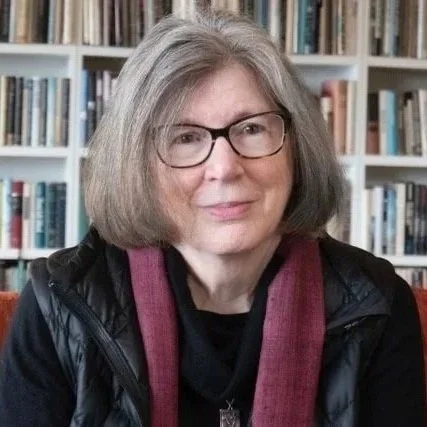
Andrea Carlisle is the author of a collection of essays on aging, There Was an Old Woman: Reflections on These Strange, Surprising, Shining Years. In Spring 2026, Oregon State University Press will publish a 40th Anniversary Edition of her fictional tales about life in a houseboat on an Oregon river, The Riverhouse Stories. Her work has been published in literary journals, newspapers, magazines, anthologies, and by independent presses. Learn more at andreacarlisle.com.
Isabella Manhart (they/them) is an undergraduate at the University of Nebraska at Omaha studying English Language Arts Education and Creative Nonfiction. Their playwriting has been featured in the 2025 NYU New Plays for Young Audiences Festival. In their free time, they enjoy traveling, ranting about urban planning, and parenting too many houseplants.