
“One Quiet Night” by Margaret F. Chen
The inn was not silent but quiet; silence implies a negative, a willful withholding of sound or spirit. Whereas quiet suggests peace, calm, and even beauty.
My husband Brian and I were staying overnight at the Mason House Inn, a bed and breakfast located in the historic, southeastern Iowa river town of Bentonsport. We had chosen the picturesque village for a weekend getaway as it was close enough to our hometown of Muscatine to not require too much travel time, remote enough to (almost) completely escape busyness and noise, different enough to feel as if we had entered a private world tucked away in the midst of pleasant woods and fields.
Muscatine, Iowa—where Brian and I first met in grade school and where we eventually reconnected four decades later, married, and established our first combined household—was, it could be argued, already a small and quiet town, but Bentonsport, as I noticed on a former visit, elevated “quiet” to an entirely different level. Here, we could drive down every street in town and not encounter a single person. Here, the river and the birds made all the sounds we needed and desired. Most of all, there was an energy to Bentonsport—a ghost town, really, for how uninhabited it seemed—that was supremely tranquil, undisturbed, timeless, and even kind. I felt safe here.
People, too, can give a sense of safety, and that is how I would describe Brian—he has a good vibe, one might say. Brian was the only classmate to ever ask me to skate with him during our grade school’s many roller-skating parties (I attended only one); later, he was again the only admirer who wrote in my yearbooks, “to a cute girl and friend.” These were unusual and supreme acts of bravery and independence, I was certain, especially for a boy as shy as he was, especially as I didn’t look like any of the other kids at school. I was, instead, loudly and frequently reminded by a few unkind classmates of my otherness. Growing up in Muscatine, it was well known that the brown, skinny girl with the bowl cut was born on the other side of the world, on an island called Taiwan. My classmates’ taunts indicated they didn’t think much of my place of birth, but I remembered beautiful mountains and kind relatives. My memories were protective, even if they existed at a small, subterranean level (I had left Taiwan at the age of three).
It was another good memory that served me well decades later: the fateful moment when cheerful, charming, and nonchalant Brian Halligan, a fourth-generation Muscatine resident and fellow fourth grader, walked over to shy, quiet, and bookish me, alone on the sidelines of the disco-light saturated rink and asked if I’d like to skate. The rest, as they say, is history (although it would be forty-seven years later before we went on a date and skated together again).
After Brian and I married in 2025, we searched for the perfect honeymoon destination. We hadn’t been able to agree on anything before the wedding, and both of us were busy, with limited funds and little time off. Bentonsport, which I discovered the previous year, was a possibility, but also an unknown, a wildcard for something as fraught with emotional significance as a honeymoon. Finally, we coordinated our vacation times and reserved a room at a quirky, historic hotel known for its attractive views, just for one night, to “check things out.”
We started our trip on a lovely summer’s day. When Brian and I arrived at the inn, our host, a friendly young soul, greeted us inside the front hall in her pajamas (she wasn’t feeling well that day). After a quick, chatty check-in, during which she imparted in an efficient manner a great deal of information about the town and the house, she disappeared again into the interior depths, and we were left on our own until breakfast the next morning.
To access our room, we had to climb a narrow flight of stairs, which was rather exciting, especially because we encountered yet another set of stairs going straight up into a darkened, roped-off area (we heeded the sign, however, which requested we not enter the next floor). Our second-floor corner suite included two rooms and a private bath. There was a main bedroom with two windows, one facing west, the other facing south and overlooking the river, and a smaller sitting room with a spare bed. We set our things down in the smaller room and assessed our surroundings—we admired the colorful, handmade quilts covering the beds and the walls, pointed out to each other the antique rocking chair, the vintage glassware and hurricane lamps, the old dresser, discussed the small landscape paintings, even smaller mirrors, and what looked like a set of porcelain chamber pots. The rooms were delightful, everything we had cautiously hoped for, and the view of the Des Moines River and the bridge from the south window was equally enchanting.
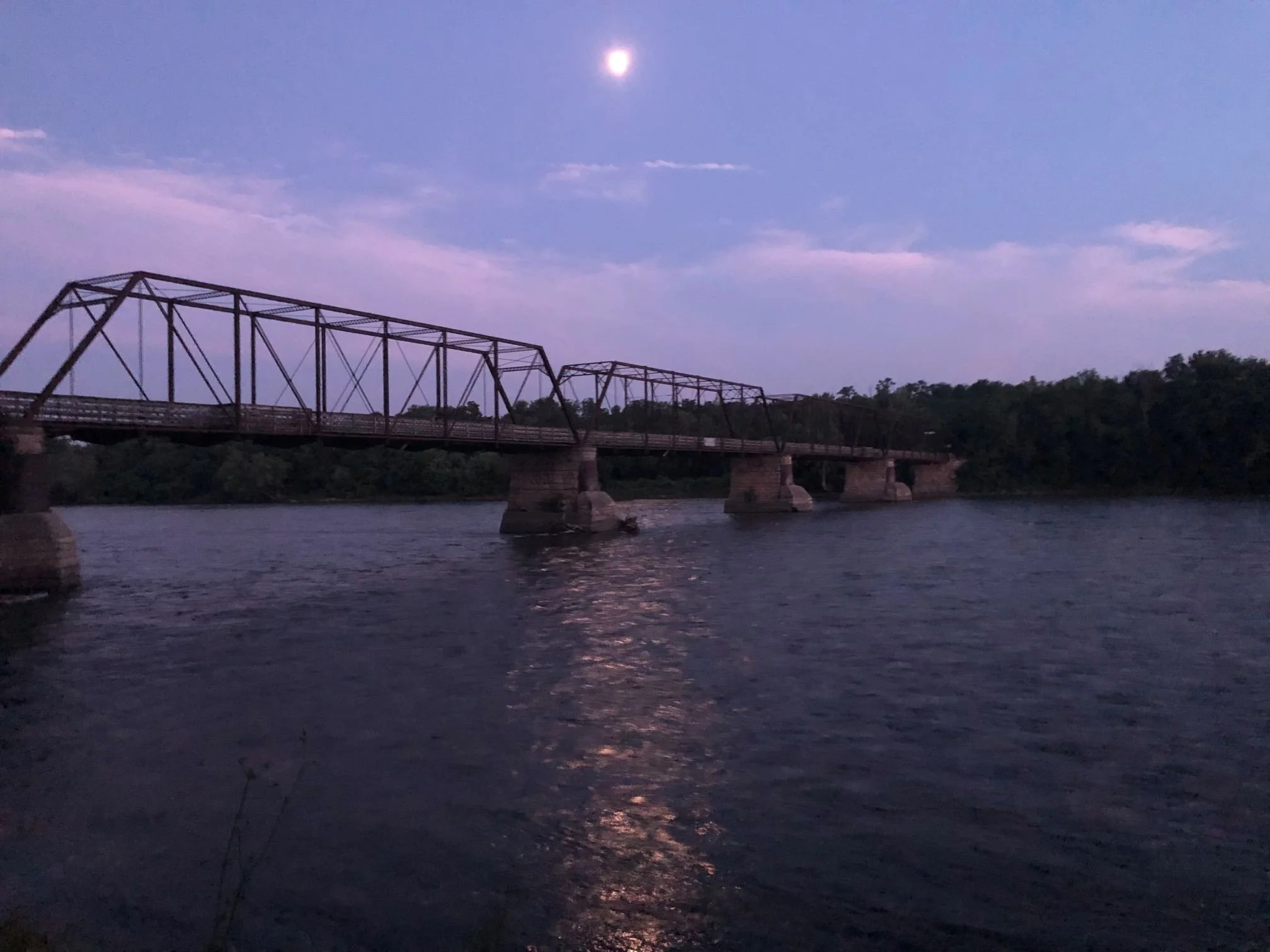
Later that afternoon, we visited the old Methodist church, as empty as the streets and the inn but unlocked and mysteriously well-maintained, and walked back and forth across the old iron bridge. Shortly before dusk, we found ourselves in the small park-like area at the foot of the bridge, intriguingly decorated with a few strings of hanging lights, and caught sight of four or five variously sized shadowy figures scampering across the lower part of the structure, an assorted group of some sort of animal—we guessed raccoons—although they very well may have been elves or small trolls, for all we knew.
The bridge-crossing creatures only added to the mystical and mystifying quality of the day and of the town. Back at the hotel, we had no idea where the innkeeper had gone and didn’t see or hear from her again until the next day. And as our inn was reputedly extremely haunted, I had a difficult time settling down for the evening, too busy searching for spectral presences in dark corners, under the beds, inside the vents. Brian inspected the hallway outside our door and checked the furnished backstairs sitting room around the corner. We both eventually gave up looking and just lay still on our comfortable bed and listened. We listened very hard, very carefully, for much of the night, but the house remained utterly quiet—there was not a single supernatural (or even normal) nightly creak or thump, only the occasional friendly chirping of crickets.
Finally, tired but unable to sleep from all the listening and the lack of obliging disturbances, we pulled up the blinds and were treated to an extraordinary sight—a waxing moon shining high over the bridge and upon the moving water; it was a scene more beguiling, more magical than I could have ever imagined, especially as it was accompanied by the quiet of the surrounding town, woods, and fields. Our moon traveled slowly across the nighttime sky, shining its rippling path upon the river and capturing moving snippets of the fast-flowing current. On both sides of this lighted path lay unending darkness. We were mesmerized by this view until the moon disappeared behind the trees, taking the lighted path with it. Only then did we finally fall asleep.
Days later, a friend asked about the visit—if we had seen or heard any ghosts—and I found it amusing to report it had been the most peaceful and unhaunted place I’d ever been in. I am sure all of us have spent enough time in haunted places, in homes and cities not designated as such, but environments which did not provide serenity or rest. I am grateful our little adventure, a night in the “haunted” Mason House Inn on the banks of a happy, rushing river, in the midst of a nature-shrouded ghost town, had given us not just our elusive honeymoon (realized after the fact), but enough calm, mystery, beauty—and quiet—to us last a long time.
Margaret F. Chen is the author of Suburban Gothic, Tales from the Eleventh Hour, and Three Terrible Tales. She grew up in southeastern Iowa and studied at Iowa State University before earning her MFA in creative writing from Lesley University. She and her husband and cat, Cinema, now live in San Diego.