
Benediction
Leo Crawford
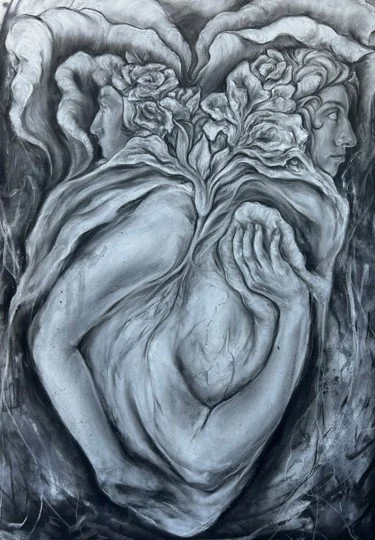
Simon Miller, A Beat of Contemplation, 2025. Charcoal and ink, 30” x 42”
It was close to midnight when we arrived. An entrance glowing amber. A smile waiting at the door. I hadn’t planned on being anywhere that night. My body felt frayed, worn thin at the edges from weeks of mindless work. My boyfriend finally convinced me to step out for air and a drink. I’d imagined a quiet bar. Somewhere with low light, soft music. Somewhere we could lean close and speak quietly. But after one drink at a dive down the street, we weren’t ready to go home. Not yet. We drifted through Capitol Hill, his hand steady in mine, until the bass from a nearby club rolled up through the cracked pavement and lulled us in.
Inside, people in black leather and sheer mesh drifted past us like smoke. The main floor was almost bereft—low ceilings, dark flooring, amber bulbs strung along the edges of the walls, a single pool table near the center with fringes falling from the ends of the scratched wood. Conversation pooled in the corners where stools lined the walls, tucked in the shadows. Underneath, bass music throbbed, steady and insistent. At coat check, the attendant slid both our jackets onto a single hanger—my worn leather swallowed beneath his blue denim—and passed us a small cardstock ticket. 173. My hands trembled with anticipation as I tucked it into my wallet before we began our descent down the stairwell.
Downstairs, the dance floor was scattered but not empty. People stood in loose constellations, as if waiting for something. A few small groups bobbed with drinks in hand. Off to one side, in what once must have been a neighboring building, a smaller barroom opened up—a rough wood bar counter, metal tabletops, stools pulled close together. The two spaces were joined now, but between them a narrow alley remained, roofless and cold on the far end, a strip of night caught between brick walls that you could only reach from inside.
I ordered a vodka Red Bull. My partner ordered a Sex on the Beach, unsure what it was, but delighted by the orange wedge hooked over the rim. The music swelled, pressing into our chests like a second heartbeat. Beyond the bar, the alley offered a draft of air. “No Smoking” signs sagged along the brick, mostly ignored by the clusters of people exhaling pale blooms into the dark.
Years earlier, I’d spent countless nights praying to be made clean. I used to think God could fix me. I’d kneel beside my bed, forehead pressed to the mattress, begging for Him to scrape away the parts of me I couldn’t stand. Scrape the rot from my brain like you’d scrape the flesh of a grapefruit. I tithed my guilt to the silence. Offering up shame like a burnt oblation, hoping the echoed silence meant I’d been heard. I thought if I prayed hard enough, long enough, He’d flip a switch. That I’d wake up pure. Saved. But each morning was the same. Same skin. Same hunger. Same heart. No response. Eventually, I stopped praying for change. I just wanted an answer.
I used to believe desire and guilt were one and the same. Alone in my parents’ house—sheets pulled over my head like a personal confessional—I remember watching two men kiss on a screen in the dead of night. The pleasure was real. So was the shame. I didn’t yet know how to separate them. The way one man cradled the other's head, the tenderness in the cup of his hand, the gentle caress of lips on neck, on jaw, on waiting lips. I paused and rewound the kiss again and again and again. I mimicked the way he touched him, tracing the curve of my own chest, my waist, my thigh. It felt holy. It felt wrong. I cried. I slept. I woke with no more clarity than I had the night before.
My first love was in my sophomore year of high school. He, a conflicted Muslim; I, a conflicted Christian. We met in the narrow space between doctrine and desire. With him, I learned love as secrecy—something exchanged in the passing of darkened hallways or in the privacy of my car, parked miles from home. Secrecy became second nature. My first love told me we would both be damned to an eternal hell, a punishment for our crimes against God. The crime of my lingering gaze, the weaving of his fingers into mine, the chaste kiss we’d share when no one was around.
His mom was the one to finally catch us, six months into our furtivity, uncovering my love note along with a bottle of glossy purple nail polish in his sock drawer. We broke up and he was quickly sent back to Iraq at her insistence, in the hopes of finding himself there. When he returned three months later, he was no longer the boy I had once fallen in love with. It was then that I understood what shame could do to the body, how it could hollow someone out and replace it with righteousness.
Now, nearly four years later, my lover and I are sitting off to the side, drinks half gone, people watching. The room thrummed as music, bodies, and breath all converged. Each beat buzzed in my ribs like a struck bell. I had never been to a club like this before, much less a gay one. My stool rocked each time I reached for my drink. A dancer in pink lingerie swayed beneath pulsing lights onstage—bleached buzz cut, long pink lashes, tattoos trailing across her skin like a roadmap. Next to her, a man in leather boots and what can only be described as a Speedo, arms waving over his head. Ones and fives were tucked beneath their straps. All I could do was absorb everything happening. The floor thickened as time passed, bodies shimmering under purple strobes and sporadic white lights. Skin replaced fabric as shirts were shed like second selves.
Here, we were the odd ones out, fully clothed among mostly bare skin. Bystanders. I once thought flesh was a thing to be crucified. A thing to be hidden and punished—poked and prodded—but never worshipped. Here, however, it was something else entirely. It was seen, alive, glowing, loved. My boyfriend peeled his shirt off first, pulling it over his head in one quick tug, and tied it around his waist. I fumbled with the button on my collar, following his lead. I awaited the shame that would find me in the gesture, but it never came. I unfastened my shirt, sliding the fabric from my arms, and tied it to my belt loop. He met my gaze with a warm smile while leading us into the crowd. It felt enlivening to be another body surrounded by bodies, existing intimately with another man without question or apology or guilt.
The center of the floor smelled of sweat and sharp cologne. Cigarette smoke wove through the air in lazy curlicues. A zing of a lime peel clinging to the rim of a half-empty glass and the flesh of a slice of orange crushed beneath stomping feet awakened the senses. The lights flashed again—pink, then blue, then blinding white—before violet shadows swallowed us whole. For a second we were exposed, then lost again. Patterns of hands, arms, chests, and backs melded into one.
Shame and secrecy had become so natural that stepping into a space absent of it felt foreign. It was the first time I understood true liberation. I believed love was something to be earned. I understood in my heart it wasn’t wrong to love—or to be loved—by another man, yet something quieter within me couldn’t believe I deserved it. Love looked soft and familiar. I wanted it. I figured that was the ugliest part. The wanting. The ache for something tender. I hardened these longings, hoping the shame could starve them out of me, as if I could make peace with being a body full of want.
I couldn’t.
Thank God I couldn’t.
I remember the benediction of his lips on my shoulder, my neck, my face. His fingers scribbled scripture down my spine. Every touch felt like the answer to a question I had yet to verbalize. For a moment, everything turned slowly. I could hear the silence I used to pray into. The same silence that was often met with more silence. And here he was—this man, this body, this warmth—answering with something softer than words, gentler than silence. For the first time in my life, I did not fear being seen. I did not brace for guilt. My body felt truly holy.
Leo Crawford is a university student currently studying sociology. He often spends his time sketching, crafting, and writing with a focus on the intersections between sexuality, race, and identity. He will graduate in 2027.