
Review: Breath Taking by Jessica Fein
Reviewed by Denise Forrest
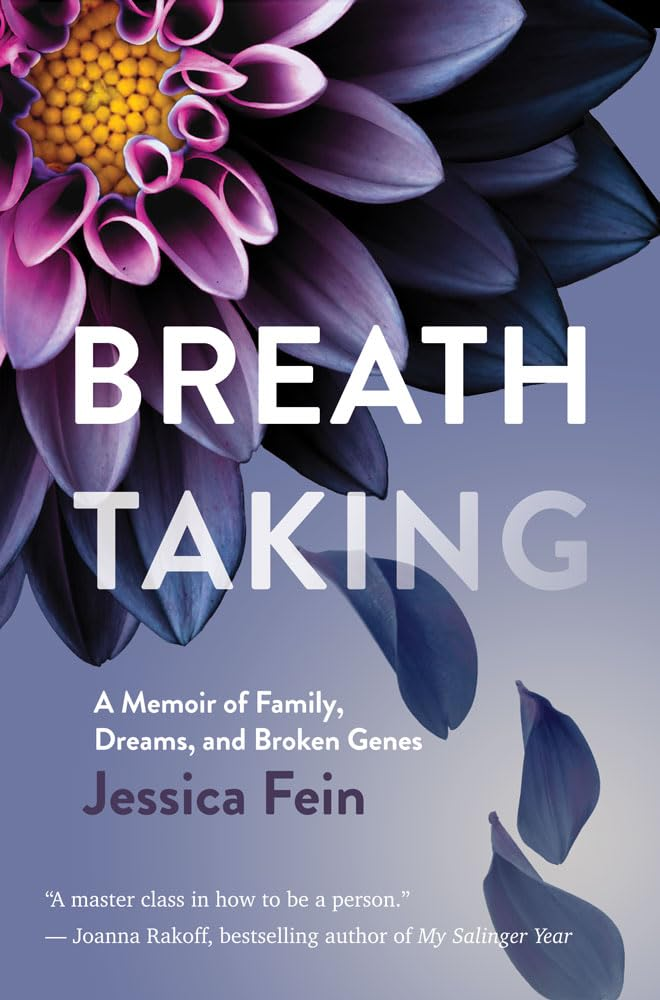
From the very opening pages of her memoir, Jessica Fein makes sure we understand: her daughter died. She promises, though, “that’s not what this book is about.” Even so, I was skeptical. I went into this book prepared to grit my teeth through a chronicle of relentless heartbreak. While there is plenty of heartbreak in this story, I repeatedly found myself pausing to contemplate Fein’s beautiful, insightful reflections on love and grief.
The narrative begins with Fein’s experiences pursuing parenthood, including varieties of fertility treatments, attempted surrogacy, and, eventually, international adoption from Guatemala. Fein’s life with her husband and three adopted children seems to be on a stable path, when she notices her daughter, Dalia, struggling with her balance. What at first seems to be merely a diagnosis of mild hearing loss is soon revealed to be an extremely rare, degenerative, and uncurable genetic condition.
Breath Taking explores many heavy themes, without offering any clichéd or pat answers to how she or anyone should feel or deal with them. Fein tackles topics as diverse as the international adoption process and her complex feelings around knowing her child’s birth mother, navigating the education system with a medically complex child, systemic unfairness in the medical insurance process, being brave for her children while still giving them the space to experience and express grief, and keeping the romance alive with her husband in the midst of years of relentless stress.
At times, Breath Taking reads like a brutal medical chronicle. The parts of the text that narrate Dalia’s medical emergencies capture the urgency and terror of the experiences. Descriptions of the interminable months of Dalia’s hospitalizations and the waiting for health improvements that sometimes never come palpably evoke both Fein’s boredom and impatience. At other times, the book reads like a catalog of tragedies, with the author herself noting that a friend compared her to the biblical character of Job. One of Fein’s sisters dies of sudden cardiac arrest a short time before Dalia’s adoption. During the course of Dalia’s illness, Fein also loses her other sister and both of her parents to quick-onset terminal medical conditions.
What I feel sets this book apart from other memoirs that narrate sobering tales of family and medical trauma is the deep personal reflection that Fein brings to her experiences, often through the lens of a complex relationship with her Jewish faith. During her daughter’s hospitalizations, she reflects how a person going through the agony of fear for their child turns to prayer. She writes, “You bargain with a god you’re not sure you believe in.” While her personal faith experience is complicated, Fein’s Jewish cultural and religious heritage are central to her sense of identity, how she makes meaning of her experiences, and how she finds the strength to live in hope. When her daughter is on the edge of being able to join a medical study with the potential to drastically improve her quality of life, Fein writes about how sitting around, waiting for good news went “against the very core of my being. I believed in hope intertwined with action.” She sees the origin of this action-based optimism in her father’s Passover lesson that “we are asirei tikvah – prisoners of hope,” a concept she defines using the words of Martin Luther King, Jr.: “We must accept finite disappointment, but never lose infinite hope.”
One of the parts of the narrative I found the most moving was the journey Fein went on with her Jewish temple community to help Dalia experience her bat mitzvah. By the time Dalia was old enough to go through her coming-of-age rite of passage, she was unable to speak or read, both of which are usually required during the ceremony as the child-turning-adult reads aloud from the Torah in the synagogue. I was truly touched by Fein’s description of the myriad ways her faith community and family celebrated the things Dalia was able to do and worked to ensure that, in the words of the temple’s cantor, “she could have a bat mitzvah that was meaningful to her and honored who she is.” The beauty of the day helps Fein resolve to celebrate life with Dalia and not “waste a minute of her life grieving prematurely.”
There are certainly parts of this book that may make readers reach for a tissue. Objectively, the cards that are dealt to the author and her family in terms of unfair burdens seem like more than any one family could possibly bear. Yet Fein never wastes her readers’ time with tired aphorisms or empty inspirational quotes. She writes with honesty and vulnerability about the grueling realities she lived through, striving to help her readers understand how she, and we, can find ways to live with the bravery of hope in the face of grief. Go into this text prepared to travel with one family on their tragically unique medical journey; leave with a better understanding of what it means to live life with compassion and hope.
Denise Forrest is a Jewish-American public school educator with 18 years of experience teaching middle and high school Spanish and Spanish Language Arts. She has a TESOL graduate certificate, an MA in English, and a Creative Nonfiction Writing Editing and Publication graduate certificate, all from the University of Nebraska at Omaha. She was twice awarded the UNO English department’s Wardle, Spire, Lane Graduate Fellowship. Her writing often explores the complexities of intersectional identities, especially in the context of language learning. You can visit her website at deniseforrestauthor.com.