
Interview: Wes Jamison
By Rebecca Miller
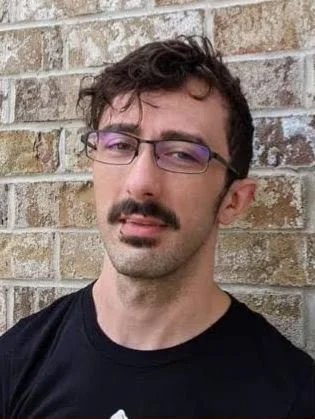
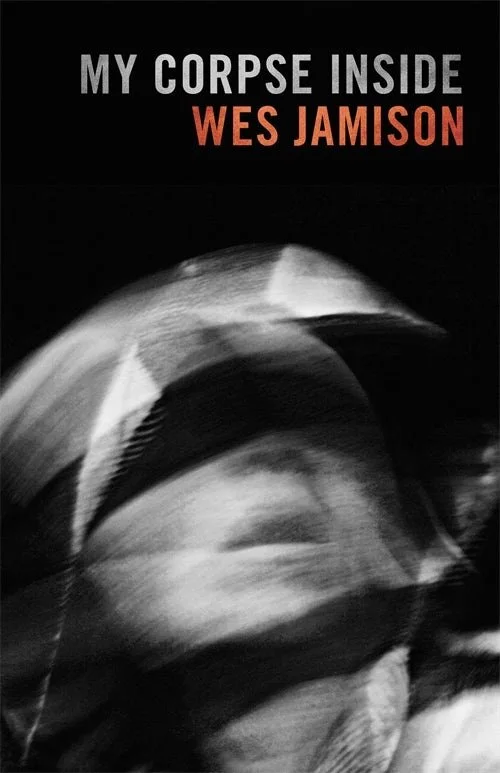
In their experimentally structured book, My Corpse Inside, Wes Jamison utilizes their own experiences to illustrate common, universal human struggles that result from interactions with dark, disturbing, and often vulgar content from the internet. Jamison illustrates stories of sexual fetishization, abuse, violence, grotesque and gross content that are easily accessible online for people of (pretty much) any age. They write: “The corpse represents fundamental pollution. A body without a soul, a non-body, disquieting matter.” Touching on themes of body, language, identity, and connection, Jamison interweaves the voices of other scholars, philosophers, and novelists into their exploration of the “fundamental pollution” of the internet, making for a riveting and thought-provoking work of autotheory.
I interviewed Jamison for The Linden Review and explored My Corpse Inside further.
Rebecca Miller: I’m very curious about the title. I viewed corpse differently throughout the book; I viewed it as being a figurative expression, metaphorical, and a literal corpse. How else did corpse function as a central symbol in the book?
Wes Jamison: We understand the word corpse, now, to refer to a dead human body, and there are plenty of those throughout My Corpse Inside. Most are, in fact, literal, although they are rarely just literal. The corpse is the utmost of abjection, so it’s easy or natural for us to want to look away. And as unpleasant as this sounds, I want my readers to sit with me and face it—it, the corpse, the body, or whatever it is that it represents (I know what it represents for me, and you don't need to say what it represents to you)—because we should never have to do that kind of work alone. The corpse is a reminder that we've survived our wounds.
RM: Can you explain how the experimental structure of your book arose?
WJ: Before I began writing, I had dreams and visions of this book as a formless, incoherent thing. My Corpse Inside began with a hunch (essays often do): Those videos that I knew to exist on the internet long ago—could I still find them? The first writing I did, then, was to document my research: a list of search terms and a list of results, each crossed out because they were not the videos I had been looking for. This turned into an essay on what I could not find and everything that I, unfortunately, could—in social media, in special interest communities, through the backends of websites and databases.
As the text expanded, I never considered it experimental or even fragmented. It is, very, but I was thinking of it as a series of "yes, and" and "if, then" decisions: If the internet never forgets, then. Yes, and here's another example. If there, then also here. Yes, me too. If they say we shouldn't see it—and we can see it on the internet.
Writing, my thoughts, and reality felt very Everything Everywhere All at Once. I tried to organize the book into three themed parts: phobia, obsession, perversion. This confused my analysis and presentation of Kiyoshi Kurosawa's film Kairo, as UGA Press and my reviewers generously pointed out. Only one part of the essay needed, for clarity's sake, to be in chronological order; and when I pulled that thread taut, everything else snapped into place.
RM: “Autotheory” is defined as a literary tradition that combines the narrative forms of autobiography, memoir, and critical theory. Why did you choose autotheory to explore these concepts as opposed to fiction or some other genre?
WJ: The quick answer is that I love in-betweenness, hybrids, and mash-ups; that I had work to do that could only be done in and through essaying; that autotheory inspires me. All writing is political, and autotheory exists as a politic: the body is necessary for thought, knowledge cannot exist without a body, and my body is here, even if it shouldn't be—even if it breaks the rules. Critical theory traditionally resides in an ivory tower from which many worked hard to expel me (for my queerness, mostly). Up in that tower, theory wants to be understood by the few, and I wanted to translate it for the many.
RM: Even though some of the internet content you describe is vulgar, it can open the door to useful communication, help solve crimes, and expose the truth on corruption or various forms of abuse. When it comes to our consumption, how far is too far? How do we negotiate the advantageous aspects of the internet along with the potentially harmful aspects?
WJ: I think "too far" as well as "far enough" would be a matter of culture, conscience, and superego. Yes, and it's more complicated than that. We know already that algorithms are designed to nudge us toward not only more but also more extreme; so the longer we are connected online, the more our feeds are tailored to push us past that line previously marked "too far." Another issue is that, once we log in, that connection is reciprocal. If we wish to reach out to others, we must first be reachable. The internet is amazing for being a community and repository for all people, identities, and cultures. And that means that not everything we see will align with our superego and conscience. I wonder, then, if the aspects we consider advantageous aren't the exact same aspects we consider harmful.
RM: Many of the topics throughout your memoir require a great deal of vulnerability on your behalf. How were you able to protect your emotional and mental health while sharing these stories along with exploring the disturbing content from the internet that you discuss?
WJ: If you had asked this question while I was still in it, writing it, I likely would have said "nothing," for all the ways this book immobilized and triggered me. Even though the book (and by that I mean me, the author) put a significant strain on my relationships, things weren't any worse because I was fortunate to have such a generous support system. I was careful with my mother and partner, especially, in what I disclosed from the book, but I shared everything with my mentor and my best friend. They were there, from the beginning, supporting me with statements like, "Being queer is already being queer enough," "You are safe," and "There's someone out there who needs to hear this."
Wes Jamison holds a PhD in Creative Writing, an MFA in Creative Nonfiction from Columbia College in Chicago, and a BA in English from Otterbein University. They have won multiple awards for their writing, two being the Quill Prose Award for the Red Hen Press and the Anderson Award in Medieval Studies. Jamison enjoys introducing their students to lyric essays and graphic narratives. Their newest experimental memoir My Corpse Inside can be found on their website at www.drwesjamison.com/books.
Rebecca Miller is an undergraduate student at the University of Nebraska Omaha, where she studies fiction and creative nonfiction writing. Originally from a small town called Weeping Water, she has been passionate about learning everything she can about the world around her and using those experiences in her own writing. She is dedicated to learning more about the field of writing every day.