
Agunah: A Chained Woman
Joy Krinsky
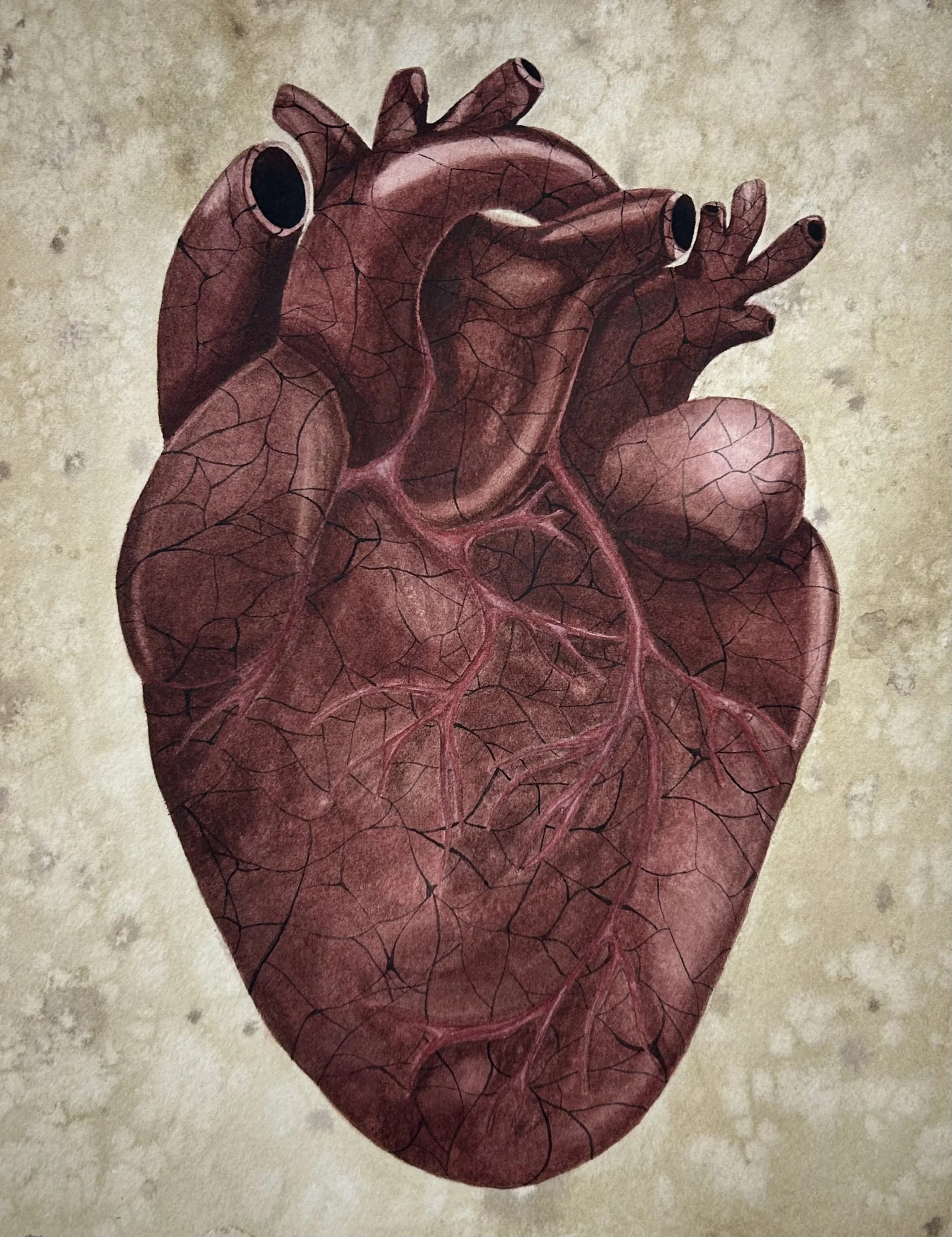
Juliana Scheopner, Grief, 2024. Watercolor, 10” x 8”
Agunah. In Jewish law, a woman cannot remarry if there is any uncertainty—any doubt at all—that her husband is truly dead. If he is missing. If he has abandoned her. Or, if he has left her and refused to give her a get, the Jewish divorce decree, she is considered agunah, and she will find herself restricted in what she may make of her future.
Agunah is sometimes defined as “chained” or “anchored.”
I lead a Jewish life but don’t follow all Jewish laws and customs, with their seemingly never-ending enabling of sexist strictures. However, as is the case in much of life, that which repels me also attracts me, and vice versa. So here I am, contemplating my experience as agunah.
Maybe it is because we can’t write our own endings. Well, most of us can’t. Or at least opt not to.
Agunah. David is quite surely dead. There is no uncertainty. There is no doubt. There are witnesses. There is a death certificate. In fact, there are two death certificates. Before the death certificates, there is a suicide note. And before the suicide note, there are texts. And unanswered voicemails. And a conversation.
Maybe it is my attempt at posthumously repairing a deeply broken marriage.
David’s and my wedding ceremony borrowed from the traditions of my Jewish ancestry and upbringing. We were married under a chuppah, constructed of hand-hewn poles created by a friend and a fabric canopy awning crafted by David. Blessings were made, wine was shared, and a glass was broken. The ceremony was officiated by an ordained member of the Jewish clergy. We did not include the veiling of the bride’s face or the bride circling the groom, nor was there a ketubah, the marriage contract. Ours was a civil ceremony. It had to be. David was not Jewish. And though our marriage was outside of Jewish law, and therefore not bound to it or by it, the double helix that winds the sinew of my body to the fiber of my soul vibrates and resonates with a truth that is agunah.
Maybe it is a ghost accompanying me.
I am chained to a spirit, an ethereal presence, that comes to me in visitations and dreams and the objects around me. In this palpable absence, he touches my world. Messages are left behind, and found . . .
In a ceramic vase that he made over 30 years ago, which, a couple of years after his death, is smashed by a falling window shade, revealing the vessel’s beautiful interior. Look at me, he says. You will repair and rebuild our family.
In my amulet pendant where the clasp worked perfectly for 10,000 days, yet one morning, it is already broken when I rise to put it on. So for the first time, I wear the amulet I gave to David instead. Remember me. We shared.
In a misplaced and long-forgotten scrap of cloth, a torn strip of handkerchief, from kriah, the ceremonial tearing following burial—though in his case, cremation—suddenly revealed in the front of a bedside drawer. Do not forget me.
In a sculpture from his student days, hundreds of pounds of cement, set in our garden, one day tipped asunder. Do not take me for granted.
And in the childhood gift from his father, an army jacket for a five-year-old, the name patch “DAVEY” stitched over the right chest pocket, now carefully folded and put away on the back shelf of a closet, that one day appears splayed out on the floor in the middle of the bedroom, nothing else amiss. Hineini. Here I am.
Am I the one anchored? Or is David anchored to me?
Maybe this is always the case in an unattended death, when the end can’t be marked decisively as an end.
In the beginning, the one that came after the ending, I would often think, “David would approve of this . . .,” be it rearranged furniture or new pull knobs on a dresser. Even two years later, when I replaced the bathroom rug, I pondered, “What would he think . . .?”
Now, more than five years later, I find myself in occasional conversation with him. Though brief, the words come easily. Out of the blue, I utter, “The kids did it. They both graduated college.” Or, “We are still standing. The house is still standing.” Or, “Babe, we are okay.” Because even with all the suffering of a life together and the brokenness of a life apart, there is still a connection, my agunah, and I continue to call him “Babe.”
Maybe it is the cremation instead of a traditional burial ritual, with its coffin and the weight of a body, a corporeal heft in a pine box, lowered—slowly lowered—and handful by handful, and then shovelful by shovelful covered by earth and into earth.
One day, a few weeks after his death, I stepped into the bedroom, and there was an undeniable smell in the room. I called one of the kids in to confirm that they smelled it too. Not a cologne or aftershave, not his breath, or mouthwash, not even body odor, but something else. His essence, the smell of his presence in our bedroom. A scent I did not even notice was gone until it entered my nose that day.
There is no doubt about his death. With it came the end of a marriage, one that was, frankly, at its end already. When David died, I was automatically “unmarried.” Unceremoniously so. Yet, in some respects, I feel more married now than ever before. Or if not married . . . well . . . chained, connected, linked, attached. Agunah.
Author’s note: This essay is about my spiritual and metaphysical experience explored through the lens of the Jewish status of Agunah. It in no way is intended to describe, supplant or downplay the very real and serious plight of the many women in Jewish communities who are considered agunah, are chained in their marriages, are not given a get (Jewish divorce decree) and in many cases suffer great abuses and extortion. For more information, visit www.getora.org.
Joy E. Krinsky began writing in the summer of 2019, first with the obituary, and later the eulogy, for her spouse. Since that time, she has studied healing through writing, and is currently working on a memoir, Every Little Thing. The memoir explores the experience of holding a family together following the dissolution of marriage and then a suicide, through a lens of Jewish texts and rituals and through the meanings that memory and objects hold. Joy’s essays have appeared in Herstryblg.com, EpistemicLit.com, and in Perhaps There Is Hope, A Tisha B’Av Supplement (the Academy for Jewish Religion). She was nominated for a 2025 Best of the Net. Joy lives in Portland, Maine.