
Fugitive
L.J. McCray
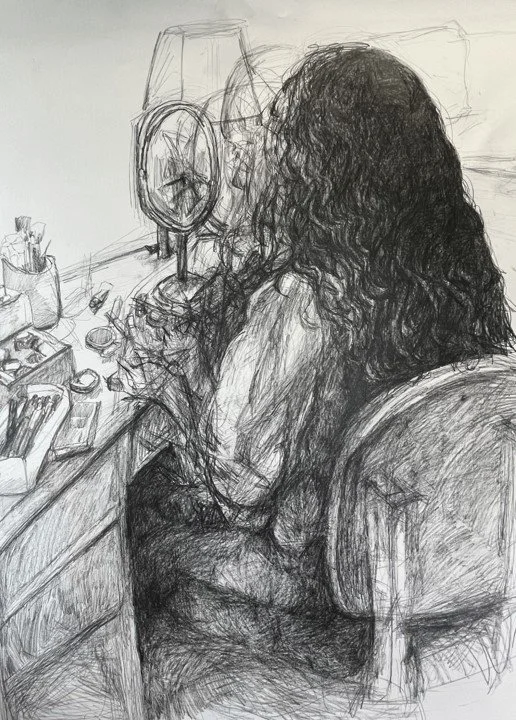
Hayden Johnson, The Routine, 2024. Graphite, 48” x 60”
In the days before I went to treatment, I ran on autopilot, fueled by panic and something I could call the hand of god. I could also call it the astounding strength of that one undefeatable sliver of me that still truly wanted to live. I made feverish preparations while the part of me that did not want to live screamed in my face.
My phone would be locked up once I arrived, but I was told I could have an MP3 player. Three months of treatment sounded scary, but three months without music while in treatment sounded impossible. I spent hours, days, hovering over my computer while I burned CDs and recorded playlists and then edited it all so it was coherent enough to find on the quaint little device my husband found for me online. We opened our long-neglected boxes of CDs, and I chose things I loved and a couple things I hadn’t heard, things that belonged to him. One of those was Swamp Ophelia by the Indigo Girls, his favorite album of theirs.
I arrived at the tucked-away treatment center for women in Colorado on December 7, 2020, before COVID vaccines and in the midst of somewhat-easing lockdown restrictions. The protocol was for me to quarantine until I had a negative COVID test result come back. But there was an outbreak in the treatment center’s main house the day I arrived, so I ended up staying alone in the quarantine apartment for over two weeks, safe as could be and scared out of my mind. In the chaos, I was allowed to go walking first thing in the morning without an escort. I wasn’t a flight risk or even an addict, so I guess they figured I’d be okay. (I’d come willingly, and despite my pronounced terror, I planned to stay. All I knew was that I suffered from something else that lands you in a treatment center, and I had yet to discover exactly what that was.) So each morning, I’d put on my many layers, take out my MP3 player with its horrible rattling earbuds, press play on Swamp Ophelia, which began with the song “Fugitive,” and set out alone.
As the guitar and orchestration swelled from a rumble to a surging, soaring melody, I too would surge toward the Roaring Fork River, which was also surging. I’d sing along quietly, short of breath from my anxious pace on the greenway: “I’m harboring a fugitive, a defector of a kind, who lives in my soul, drinks of my wine, and I’d give my last breath, to keep us alive . . . .” I learned the words by heart as I watched ice floes glide downstream in the dawn light, vapor wafting off of them. I’d see hundreds of Common Goldeneyes, looking anything but common to me as their tuxedo-black backs flashed into pure white underbellies when they took flight all at once off of the icy water. I’d watch my breath puffing through the mouth-hole in my ridiculous rainbow balaclava that didn’t seem so ridiculous now that it was well below freezing, the sun behind the mountains and the wind blowing in my face. I’d listen and sing along to this mysterious song, not really understanding it but feeling its urgency and desperation, and finally, the release of it, way down in the recesses of my hidden heart.
In this way I adjusted to the altitude, and to the whole idea of being there, in Colorado, at a treatment center. And to the whole idea of being here, on the planet, for that matter. I walked at my own pace. I was neither fast nor slow as my ski pants swished against themselves and my heavy boots thumped prints into the snow, far more assuredly than I felt. My anxiety walked alongside me, and so did my courage, the three of us breathing heavily and bowing internally to the benevolent oppression of the unrelenting beauty that surrounded us. I saw bald eagles in flight, a river otter, the sun kissing the tops of the trees as it braced itself over the mountain ridge in the morning and at sunset. Though my anguish had always felt like a well with no bottom, there was a limit to how miserable one could be in a place like that. On those solo walks there was no pressure, no one urging me to hurry or lingering to let me catch up. There was only every raging part of me, the wind, and the voices of the Indigo Girls reassuring me that someone else had walked down a tunnel as dark as this and seen the light at the other end.
Eventually the COVID breakout passed, my solitude ended, and I moved into the main house with the other women. I adjusted surprisingly well to living with thirteen housemates. I woke early and did cranky yoga, spent the entire day in therapy, and slept like a stone, my insomnia bested by the exhausting routine. I drew my feelings in art therapy and brushed horses during equine therapy. I talked and talked and listened and listened. I cried and laughed and felt every imaginable feeling. Each day felt like a lifetime. Most of all, I withstood the almost excruciating process of letting people—therapists and patients alike—see me, the real me, with more intimacy than I’d ever experienced. Letting myself be witnessed felt much like clinging desperately to a canyon wall, utterly exposed and in danger of destruction. I slowly learned that letting go wasn’t a dead drop but a trust fall. What I thought would destroy me is what saved me: the compassionate and unflinching gaze of the others didn’t strip me down but let me unfold like a crocus bud emerging from deep frost. By the time I left, I was almost angelic with love for myself and others. I flew home feeling hopeful, triumphant amidst my ongoing process of opening to the world, though I had no idea of all that opening would entail.
Three and a half months later, while navigating the ups and downs of early recovery, I sent a link to “Fugitive” to a friend who was still in treatment. She was gay, and it would soon turn out that I was too, but at the time I still resonated with the song only along its broad emotional lines: carrying something inside you that you have to protect at any cost. The song was a door that was barely ajar, one I hadn’t pushed all the way open. Not yet, not yet.
And then I did. One day in April 2021 I was lying on my bed, facedown, my heart twisting into itself, and a thought alit on me as a bird on a branch, deceptively gentle: I wonder if I’m gay? For years I’d identified as asexual, feeling no attraction to anyone and struggling sexually with my husband in what was otherwise a genuinely wonderful marriage. Then I felt sexual rumblings, albeit mostly towards women, and I wondered if I was bisexual, always assuming I must be attracted to men in some way. That had been my only experience. It was something I thought I’d known about myself.
I wonder if I’m gay? Just that one thought, and I cried for six months as my entire life history rewrote itself, invisible ink appearing under the searing, radiant light from that now wide-open door. My marriage was the most stable and good thing I’d had in my life for the past eleven years. My husband was my favorite person. He was one of the reasons I had been so determined to survive. My new life was a gift not only for me, but for him. We were supposed to be becoming, together—and we were, but exactly what was now a mystery.
I frantically flipped through pages of memory, unearthing signs both obvious and subtle. Sometimes whispers, sometimes neon arrows that I could only have missed because of the depth of my trauma. Once, early in our dating, I stood at my now-husband’s kitchen sink, looked at him through the wall cutout to where he sat on his couch, and told him I'd dated a woman for the first time right before he and I met. He said that in that moment, it was like a curtain fell away and revealed me. I said nothing. We blinked, and the moment passed. I never understood what he meant – not until now. I was playing a game called, “How Gay Can You Be Without Knowing You’re Gay?” My wise mind, typically painfully self-aware, had shielded me from knowing This One Thing that, as a child, then as a young adult, it had not felt safe to know. Now it was safe. Now, I could not, would not, unknow it.
On a walk in October 2021, I listened to “Fugitive” again, this time with my husband—my still-husband, who was riding the waves with me while we figured out how to stay together without the sexual relationship we’d expected; how I could date women; how we could find more choices than the world-at-large had led me to believe there were. We listened, and I remarked upon how much I liked the song, though I’d never figured it out. I asked him what he thought it was about, and he told me with certainty what I should have found obvious: it’s about carrying the secret of your sexual identity through a hard world that cannot, will not, understand you. Ironic, yes, for my husband to pithily explain to me that all along, I had been listening to a song of my queer self without understanding how much of myself it really was. He always saw the light of my truth before I could. I had been singing the story of my heart for almost a year, not knowing what the words meant. And isn’t that the way? Those things we can’t look at yet call out from the darkness to fill us with music, a song that’s ready to be sung when it’s time; a balm we stocked in our cabinet before we noticed the wound that needed it.
L.J. McCray is a queer, neurodivergent writer and poet from North Carolina. She publishes nonfiction regularly in her Substack, Existential Ease, and is thrilled to have been accepted by The Linden Review. Her poetry has been published in several journals, including Hyacinth Review, borrowed solace, Apricity Press, and Psaltery and Lyre. She has a BA in creative writing from Hollins University, as well as a master’s in divinity from Yale Divinity School. From a young age she has used her writing to grapple with grief, trauma, identity, and spirituality. You can reach L.J. on Bluesky @existentialease.bsky.social, find her on Instagram @neuro_fed, or follow her Substack, Existential Ease.