
Review: Momma May be Mad by Kerry Neville
Reviewed by Laura Johnson Dahlke
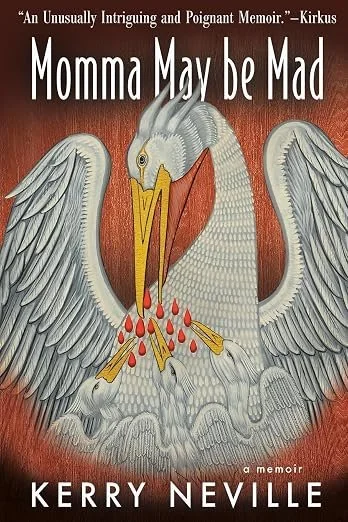
Momma May be Mad by Kerry Neville is an inventive and unique memoir about the narrator’s struggle with bipolar disorder, anorexia, self-cutting, and alcoholism. It is also a story of resilience and the drive for recovery. In this mostly nonlinear narrative, Neville’s mind is like a prism, a conduit filtering language to bend, refract, and disperse her experiences.
Neville’s story slaloms through time and space but never loses readers through the zigzag. For this, it is a triumph. To help guide readers, she includes temporal signposts like the recurring usage of the term “Pushpin,” typically followed by dates—reminders to trigger her memories and help her stay oriented.
She describes her usage of the term this way: “. . . I can locate my exact position on the planet—Pushpin—and can see the world unfurling around me and can see what else might be possible beyond my present pinned coordinates.” Neville reaches for the possibility of becoming well and living fully, the possibility of becoming the present and engaged mother she wants to be for her son and daughter. She is a master at turning something material, like her location on the planet, into something abstract, like the meaning of her existence in the universe.
Neville grounds readers by using research, offering rafts of interesting information expertly incorporated into the text. Readers learn that Ancient Greeks and Romans used a crude form of Electric Shock Treatment with torpedo fish, that St. Margaret Cortona attempted to slice through her nostrils and upper lip with a razor, and that anorexia is the mental disorder with the highest mortality rate.
Additionally, Neville interrupts the narrative with what she calls “thought particles,” such as these: “Where to start and where to go? Backward? Forward? Now?”; “But also, Here—Not here. Alive—Dead. Joy—Despair. All at once—Not at All. The skull contains chaos”; “Once lost, but found, and now still here, inside my body inside this world. And oh, what a world and what a here!!!!”
The first and longest section of the book, “Present of Things Past: Memory,” spans more than 100 pages and details Neville’s suicidal despair, offering readers an intimate account of her darkest moments. She writes, “Dear God, let me wake as someone the world might love, or at least, someone my husband love again, and if not, then die by voltage to the brain.” And later, another desperate plea: “I needed help. I needed help getting out of the muck and mire. I needed help finding the courage to climb out of the muck and mire. I needed help. I needed help. I needed help. And yet nothing seemed to help.”
This is the real strength of the memoir: helping those who do not suffer from these afflictions to better understand them. As she rightly states, “Storytelling is the path to expanding empathy.”
To treat her suffering, Neville endures twenty-five rounds of Electric Shock Therapy, numerous inpatient hospitalizations, and several rehabilitation stays. For many years, none of the psychiatric medications she tried worked. The author’s then husband tells a doctor, “Her constant misery exhausts me,” leaving little hope for recovery and for their marriage.
The remaining two sections, “Present of Things Present: Sight” and “Present of Things Future: Expectation,” focus on her recovery. She takes a solo trip to Morocco, accepts a full-time teaching position, and earns a Fulbright Fellowship as a visiting professor at The University of Limerick in Ireland. Additionally, she remains connected to her children even when away. It seems to be the best and brightest answer to the question a therapist once asked her, “Can you see what is waiting for you if you hold on?”
This is in sharp contrast to a verdict from a psychiatrist she calls Dr. Disregard, who callously tells her, “You are a hopeless case. Nothing more we can do for you.” Upon hearing this, Neville becomes angry and enlivened, ready to strive toward lasting change. She thinks, “I will show you that I am not hopeless. I will live. I will make you eat your words. I will stuff myself silly on hope. Hope Full.” It is at this juncture, after many years of misery, that she starts her recovery. The scene is one of the most memorable in the memoir and one that has personal significance to me because my eldest daughter will soon begin a psychiatry residency. It is a story I will pass on to her as she embarks on her journey to treat patients like Neville, serving as a salient reminder to be humble and navigate the clinical encounter with sensitivity and care. No one should be deemed a hopeless case or encounter a Dr. Disregard while trying to heal.
Laura Johnson Dahlke has a PhD in humanities and teaches English courses at the University of Nebraska at Omaha. She is the author of Outer Origin: A Discourse on Ectogenesis and the Value of Human Experience and other publications relating to human reproduction and technology. In her spare time, she enjoys baking sourdough bread, practicing yoga, and reading about human potential.