
The Storm
Jessica Pisano
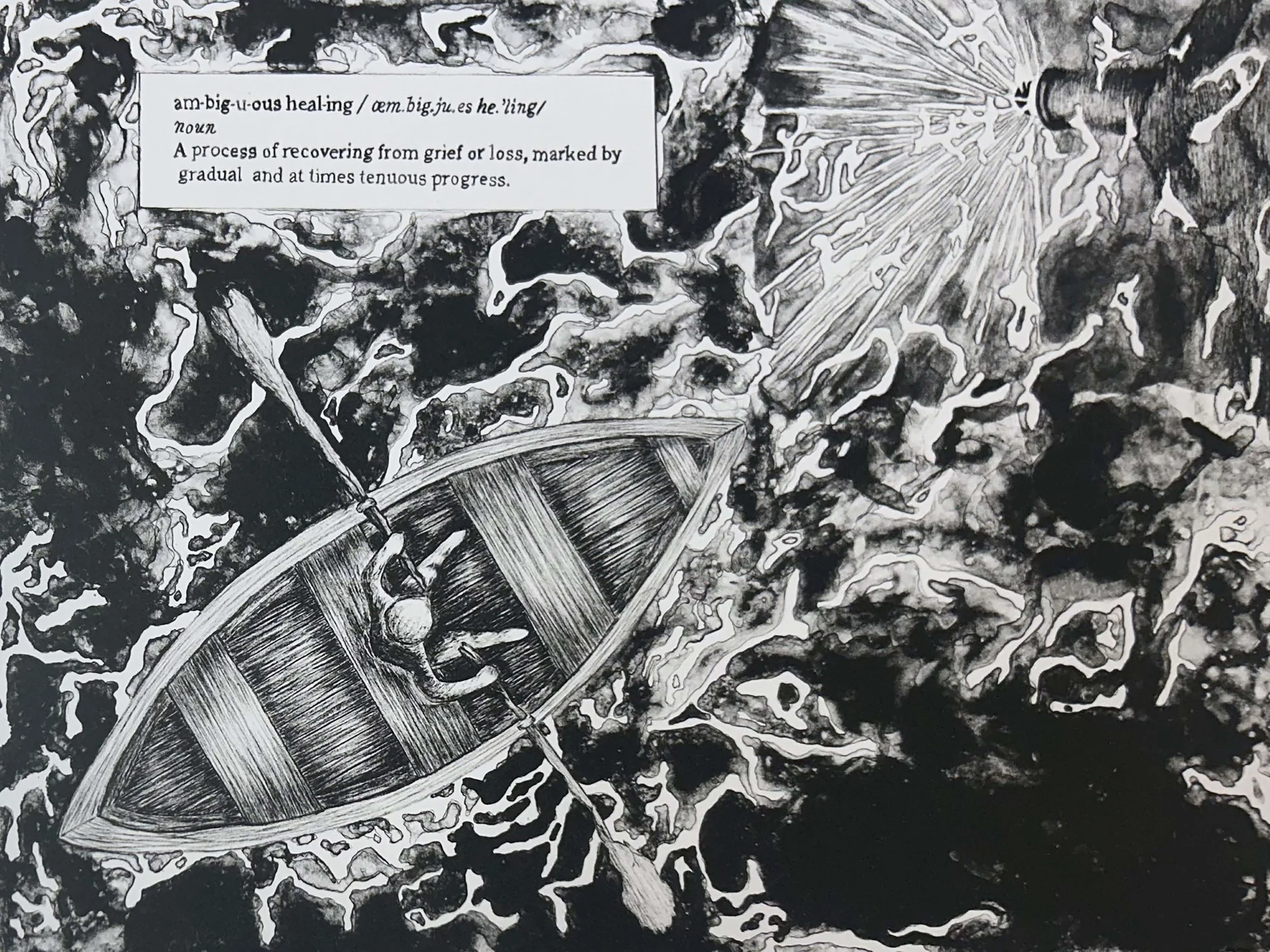
Juliana Scheopner, Reaching, 2025. Lithograph, 10” x 13”
The sun shone through the crisp early November air. It was the kind of day that reminded me why I loved the North Carolina mountain town that had been my home for over thirty years. I smiled as I drove from the university where I taught toward my kids’ schools. The district was releasing at noon for staff planning, and I had shifted my work schedule. Was I bringing my young children back to my office for an afternoon meeting? Or had I managed to clear my calendar to take them to The Hop for ice cream or to Weaver Park before gymnastics and baseball practice? I don’t remember. I know I picked Chloe up from the elementary school first. I know we were on our way to get her brother McLean from Asheville Middle when I got the robocall:
“Asheville Middle has been placed on lockdown due to a potential threat. Students and staff are unharmed but will remain in the building until local officials ensure we can safely dismiss.”
It was far from the first time my children’s schools had been on lockdown. Their elementary school, Isaac Dickson, sat on Hill Street, which wound down from stately Montford mansions towards Hillcrest, a low-income housing project carefully concealed and cut off from town on a triangular tract between two interstates and the French Broad River. More than once, men had wandered onto the school grounds midday, gripping half-empty bottles, disoriented and distraught, and the school had been placed on lockdown while police hurried them away. More than once, Asheville’s ubiquitous black bears had lumbered onto the playground, sniffing out forgotten juice boxes and gummy snacks as wide-eyed children watched from behind locked windows and doors. And more than once, the school had been forced to respond to the growing threat of gun violence in our community. Just a year back, a boy from my son’s fifth grade class had been shot and killed trying to save his mother from an ex with a gun. When his younger brother returned to school, he told his second grade class—my daughter’s second grade class—how he hid in the closet with his baby sister, watching as his mother and brother were gunned down.
When school robocalls started to interrupt my life every few weeks, announcing lockdowns, announcing tragedy, I became numb. It was a coping mechanism. I couldn’t cry all the time. I tried not to cry in front of my children. I needed them to feel safe. My refusal to cry, to admit anxiety, was itself a futile prayer for their safety. “McLean’s school is on lockdown again,” I’m sure I told Chloe, willing my voice to nonchalance. “Probably a bear. Who knows?”
But as I turned onto South French Broad, something felt different. The narrow residential street was lined with cars. School traffic was always a nightmare at Asheville Middle, but this was worse than normal. I guessed that, like me, most parents were already on their way when lockdown was called. As I drove, I glanced through windshields at the mothers, fathers, and grandparents on both sides of the street, sitting in parked cars, scrolling through their phones for news.
“Let’s see if Aunt Billie’s home,” I suggested, steadying my voice for my nine-year-old girl. She matched my composure, nodding in silence, but her eyes widened, uncertain. “Maybe we can hang out until lockdown’s over.” Aunt Billie, not my sister but closest friend, lived less than a mile from the middle school. We met when our babies were three months old, clung to each other over the years as we weathered the whirlwind of motherhood, watching our dark-haired, bright-eyed imps grow. Chloe and I were not the first to pull up to her fading mossy green Queen Anne. Other mamas with nowhere else to wait were already there, some with younger children, sipping coffee, feigning mindless chatter and reassuring smiles, one eye always on their phones.
For six hours we sat, suspended in time, and waited while our eleven-year-olds must have fidgeted, fearful, in the stuffy gym, police searching every locker, every backpack, every corner of the school. We were shaking from too much caffeine, too little food, too many remembered headlines, when the robocall finally buzzed each of our phones: Parents could enter the pickup line but must remain in their vehicles. Police would escort students from the gym to their cars. It was 6 p.m. Still shaking, I left Chloe with Billie and drove to the school. Still shaking, I waited in a car line that felt interminable. Still shaking, I caught sight of my beautiful boy and Billie’s sweet girl—a child I loved as if she were my own—their eyes wide, their hands clasped, hurried by a teacher, overshadowed by a uniformed man with a gun.
McLean has been drawn to guns since he was in elementary school. “We need one, Mom,” he’d beg, “for protection.”
“Not in my house,” I’d say, “unless it’s a rifle to hunt and provide food for our family.” His stepdad would cite statistics: handgun owners are more likely to be victims of gun violence, to have the weapons meant to protect their families turned against them.
McLean was unconvinced. “At least I’d die fighting,” he’d throw back before storming off. “You left the front door unlocked again!” Angry and afraid, he’d rush around the house, double-checking every window and door.
Sometimes, I feel angry, too. Why should my children have to grow up in fear? Knowing other children have been shot while they sat on carpet circles in classrooms with brave young teachers? While they swung from monkey bars and slid down slides? Sometimes, I bite my tongue. Why should my children not live in fear, when other children, throughout time and space, have grown up under its shadow?
I taught English in a public high school during the nine months I was pregnant with my son. The students gushed and blushed over my growing belly. We read together and wrote together. We practiced active shooter drills together. One day that winter, a noxious odor filtered into my classroom.
“We feel faint,” the students said. “We’re going to pass out.” I rolled my eyes and scrunched my lips. Anything to get out of school.
But the stench grew stronger. By second block, students had complained to administration. By lunch, police were searching the building. (Were their minds, like mine, flashing back in time to the anthrax attacks just six years earlier?) By fourth block, they were evacuating my wing, herding afflicted students into the gym. Yes, I needed to go too. They couldn't take any chances, given my “condition.” Hysteria spreads fast in high school. Soon, my students and I were hooked to oxygen tanks brought in by paramedics, shuffled onto school buses, sped to the hospital. Because we’d come into contact with an unknown substance, a possible contagion, we were rushed in through side doors—males to the left, females right—told to strip naked and hosed down in a sterile tiled room by androgynous forms in hazmat suits and masks. The teenage girls around me screamed and clutched each other. We were too scared to protest, too stunned to ask questions. I held my son through my belly, horrified he might somehow absorb the fear and chaos.
Hours later, we learned that the threat was nothing: one of the most noxious stink bombs the police had ever seen, set off in a trashcan near my classroom. But the fear and chaos had been real.
Chloe and I love to travel. McLean, not so much. He prefers home, his bed, his dogs. But he loves water, especially being underwater, snorkeling during family vacations in the Keys and Mexico.
I love snorkeling, too. Leaving the group and swimming off on my own, watching the single-minded sea life, seeing silver-scaled schools swim by, disinterested and undeterred.
“Do you like the fish?” I asked him, knowing his love of animals.
“I like the quiet,” he confessed, this tough man-child who won’t apologize for fighting the kid at school who hurt his friend but shies away from parades, concerts, fireworks. “It’s so peaceful.”
I’ll never forget the newspaper slid under my hospital door during his birth: “33 Dead, 29 Wounded in Virginia Tech Shooting.” I’d been induced, but he wasn’t budging, wanted to stay safe and warm in the waters deep within my body. How could I blame him? I remember scanning the headline through the pain of yet another contraction, throwing down the paper and staggering to the window, staring out at a gathering mountain storm. I had already been in labor for almost two days, but still I prayed, Please, not today. Let my baby be born tomorrow, not the day of this headline, this massacre. And so my son and I fought together, not for the last time, struggled together until his heart rate slowed and my blood pressure dropped, and they wheeled us, still one, into an operating room blasting Blue Oyster Cult’s “Don’t Fear the Reaper.” It was just after midnight.
My son turns eighteen next year, not long after I’ll turn forty-nine. He wants two things for his birthday: a tattoo and a gun. I offered to pay for his tattoo. No, he said, he wanted to use his own money, the money he’d earned and saved working after school and weekends at a local grocery store.
Some nights, when we’re talking and close, I’ll raise my voice: “Fifty years! Fifty years I’ve survived without a gun!”
“You’ve been sheltered your whole life!” he’ll hurl back, this child I’ve sheltered, kept alive and protected for eighteen years.
I remember the day my mother looked at me and finally said, “I have no idea what it’s like to be you right now.” I was twenty-two, living in a mountain-side cabin with a boyfriend and whatever itinerant souls had crashed there for the night. At twenty-two, she’d been married for four years, filing for adoption after trying to get pregnant for “so long.” I was born a year later.
My son is wrong and right: I have not been sheltered, but I have not lived his life. I have no idea what it is like to be him right now, to be born just after the deadliest school shooting in history. To exist always in its wake, a storm that abates only to build in intensity. To grow up under its constant, lingering clouds.
Jessica Snow Pisano has been an educator for over twenty-seven years, teaching everything from middle school English to education licensure courses to writing in a medium-security men's prison. She recently relocated from Asheville, North Carolina, to Savannah, Georgia, with her husband and daughter, three dogs, and Baby Cat.