
Interview: John T. Price
By Denise Forrest
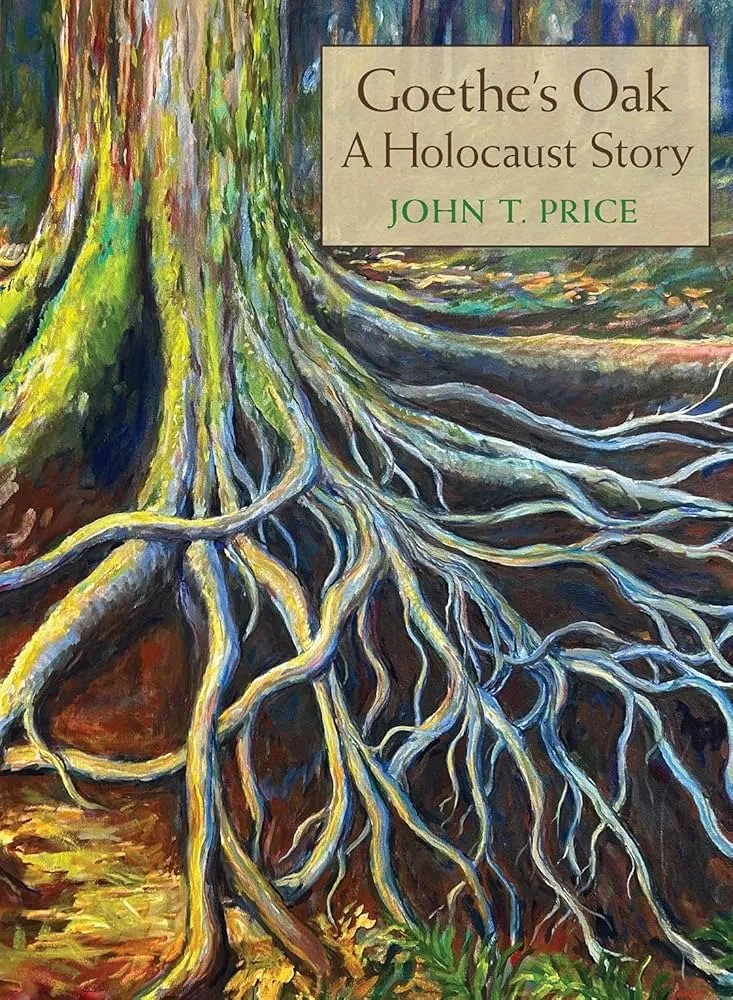
I have been a fan of John T. Price’s voice as a traditional personal essayist and nature writer since 2021, when I was a student in a graduate seminar he taught at the University of Nebraska at Omaha. I was nonetheless surprised and moved by Price’s shift to a tonally and stylistic experimental narrative approach in Goethe’s Oak: A Holocaust Story. The book is a speculative nonfiction text written from the first-person point of view of the titular tree. These vignettes explore themes as diverse as the interconnectedness of forest plant life through mycorrhizal fungal networks, the enduring power of poetry and music on the human psyche, and the love between parents and children. The most challenging themes of the book, though, are found in Price’s exploration of how the real Goethe’s Oak grew and died within the land that became Buchenwald concentration camp. As an educator of Jewish heritage, I have both read many books about the Holocaust and reflected on the ways that students learn about and process the unthinkably complex tragedy of those events. Price’s book is heavily researched, respectful, tonally accessible to readers, and a truly unique approach to the subject matter.
I reached out to him and asked him about the book and his writing process.
Denise Forrest: Writing from the point of view of the tree is a big departure from your usual style of first-person personal narratives. What inspired you to take this approach?
John T. Price: This was a decision I struggled with for quite a while, and still do, to be honest. As a nature writer, I understand the dangers of anthropomorphism. Imposing human traits on non-human beings often erases their distinct needs in favor of our own, contributing to immense environmental destruction. My visit to the remains of Goethe’s Oak at Buchenwald, however, forced me to consider anew the countless non-human victims of war who have largely remained voiceless, their stories lost. This ancient tree was a witness, in its own way, to the suffering at Buchenwald and ultimately was killed there. How might I responsibly create a “voice” for this being that would allow for such witness—or at least a meaningful version of it? This would certainly involve taking creative liberties. I decided early on, however, that my efforts would be shaped by research into tree biology, behavior, communication, and sentience, including research and writing by Suzanne Simard, Douglas Tallamy, and others. Without that research, I’m not sure I would have considered this approach.
DF: How did taking on that narrative voice stretch you as a writer?
JP: Anyone who has read my previous nature writing, much of which is autobiographical and humorous, will recognize this as a major departure. And for good reasons. In addition to the ethical complexities, I knew that telling this story would require a new approach (for me) to form and style. None of us know how a tree would “talk,” but we do know from science that trees waste nothing—water, sunlight, time, etc. I tried to take the same approach with the language, crafting sentences that were spare and yet, simultaneously, conveyed meaningful rhythms and textures. I think the result is closer to prose poetry, which I had never written. Like the subject matter, the writing process challenged and humbled me.
DF: The artwork you include throughout the book is a beautiful complement to your words. What about this text made you feel like artwork belonged?
JP: I always felt that this book should include a visual element. Something that might capture the dignity of this being beyond the words on the page. At first, I leaned toward more detailed renditions of the tree and its surroundings, but ultimately, I worried they might unintentionally limit the complex array of emotions any individual reader might bring to the story. I wanted, if possible, for the illustrations and the design of the book itself to create a more meditative space, where the meaning of the story could resonate in different ways for different readers. When the book designer suggested simple images of leaves and acorns, I was skeptical at first. But when I saw how she placed them on the page opposite each section of prose, I knew it was right. Each leaf and/or acorn image subtly resonates with the subject and feelings evoked by the prose, while also offering enough open space to invite individual reflection. Likewise, the visual presentation of each section of prose is intended to resemble the textured trunk of an oak tree. It was my hope that these visual elements would deepen readers’ connection with the story, and this seems to be the case for many.
DF: This story, though not about you, feels deeply personal. I noticed that you dedicated the text to your father. Could you tell me about how this relationship guided you as you wrote Goethe’s Oak?
JP: Thank you for this compassionate question. My father, a small-town attorney and history major in college, had a significant influence on my writing. While I was growing up, books were everywhere in our house. More importantly, our father encouraged us to read and discuss them. Especially books by authors that, he felt, taught us something essential about being ethical human beings. Two of those authors were murdered during the Holocaust—the young Jewish girl Anne Frank and the protestant theologian Dietrich Bonhoeffer (who was imprisoned at Buchenwald). Later, in college, I majored in Religious Studies, with a focus on Holocaust memoirs. These memoirs, such as Survival in Auschwitz by the Italian Jewish chemist Primo Levi, are more than books. They are an ethical force that profoundly shaped the way I understood the world and my role in it, despite growing up in vastly different circumstances, as they should for anyone who reads them. But I’m not sure I would have chosen to study these literary works of witness so intently, or taught them in future classes of my own, without my father’s influence. Unfortunately, he passed away the summer before Goethe’s Oak was published. He was, thankfully, able to read an advance copy, and he told me that, of all my books, this was his favorite. That meant more to me than I can possibly express.
DF: You did scientific research about trees, as well as historical research into the history of Goethe’s Oak and the Buchenwald concentration camp. With so much to process, how did you decide where to focus?
JP: As I mention in the preface to the book, I accidentally encountered the story of Goethe’s Oak while visiting Buchenwald in 2015. There, among the memorials to human victims, was this large, preserved stump with hundreds of memorial stones placed on top—a tradition in Jewish culture intended to honor the souls of the dead. It clearly held special meaning in the camp, but in my studies of Holocaust literature, I had never seen it mentioned. The tree’s significance was further confirmed when visiting the Buchenwald Memorial art museum, where it was depicted in several works by prisoners. Memorial staff provided additional information about the prisoners’ attachment to the tree—a centuries-old English Oak—and its legendary connection with Goethe, who (it was believed) wrote a famous love poem beneath its branches in 1776. A poem that would have been familiar to, and cherished by, many in the camp and well beyond. Even so, I could find very little written about Goethe’s Oak. I felt compelled to do so—I don’t know any other way to put it. I would first write about the tree in a personal essay published in Orion, but it felt incomplete. The history of Buchenwald and the life of the tree were intertwined and deserved a more focused treatment. But where to start? Eventually I realized that to honor the “beingness” of this tree, I would need to tell its larger life story—as I would if writing about a human being. The life of this tree, like the lives of all those who suffered and died at Buchenwald, was so much more than the time they spent in the camp. Additional research helped me imagine, in a more informed way, how it had engaged with the world around it and those beings with whom it likely experienced deep attachment. Especially the “mother oak,” a major character in the story, and other trees and wildlife in the surrounding Ettersberg forest.
DF: Once you had found your narrative focus, were there things you learned in your research that you had to leave out for the sake of the story, but wish you could have included in an essay-length footnote?
JP: So many, but one especially haunts me. For many generations, the Ettersberg forest had been a popular spot for locals in nearby Weimar (such as Goethe) to take nature hikes and enjoy grand views. One of the most disturbing discoveries while visiting Buchenwald, and in future research, was how the Nazis attempted to maintain and promote that connection to nature alongside the very visible atrocities they were committing within the camp, which they also considered “natural.” They even built a small zoo just on the other side of the fence, for the enjoyment of the families of camp officials and for visiting locals, including children. There was no attempt to hide what they were doing or to let it disturb their continuing enjoyment of the surrounding forests. This further reveals the depths of Nazi depravity. It is also, however, a reminder of humanity’s continuing capacity to ignore the suffering of others, near and far, human and non-human, while carrying on with daily life. Knowing this, we are better prepared to recognize and challenge it.
DF: This text is a very different approach to looking at the Holocaust than anything I’ve read before. How do you hope educators will see this text as a resource in teaching about the Holocaust?
JP: Though the main character is an oak tree, this book is intended to honor the millions of people who suffered and died during the Holocaust. More than 56,000 individuals were murdered at Buchenwald alone. Goethe’s Oak had its own life, preceding its time in the camp, but that life also had significance for many of the human beings imprisoned there. In honoring the oak, and the love poem associated with it, I am also honoring the human feelings and memories that gave them new meaning within the camp. Our affinity for nature and art has always, at its best, been an essential reminder of our humanity, including during times of great suffering. That affinity is part of our collective and sacred “beingness” which is what the Nazis (and all those who encourage and enforce prejudice) wanted to deny. I hope that teaching this particular remembrance of the Holocaust offers, among other things, a reminder that, like trees, we are all interconnected and that we have a continuing responsibility to act with conviction and compassion for the well-being of all.
John T. Price is an award-winning author and teacher who writes out of the wildish intersections of nature, family, community and spirit—with a special love for the prairies and oak-lands of his midwestern home. A recipient of a creative writing fellowship from the NEA, he is the author of five books of creative nonfiction and editor of The Tallgrass Prairie Reader. He lives with his family in the beautiful Loess Hills of western Iowa and directs the English Department’s Creative Nonfiction Writing Program at the University of Nebraska at Omaha. Find out more about him at www.johntprice.net.
Denise Forrest is a Jewish-American public school educator with 18 years of experience teaching middle and high school Spanish and Spanish Language Arts. She has a TESOL graduate certificate, an MA in English, and a Creative Nonfiction Writing Editing and Publication graduate certificate from the University of Nebraska at Omaha. She was twice awarded the UNO English department’s Wardle, Spire, Lane Graduate Fellowship. Her writing often explores the complexities of intersectional identities, especially in the context of language learning. You can visit her website at deniseforrestauthor.com.