
Being Third
Anna Redsand
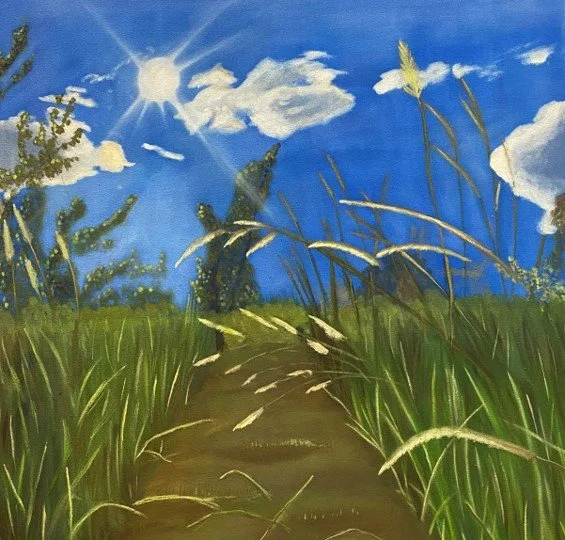
Kae Northrup, Present, 2025. Oil on canvas, 24” x 24”
The ‘third’ is that which questions binary thinking and introduces crisis.
~ Marjorie Garber, Vested Interests
It was a cool August morning in Williams, Arizona, and I was about to board the Grand Canyon Railway, courtesy of one of the railway’s entertainers. Clarence (Diné) walked me to my coach, and I had put my foot on the lowest step, when he said, “Just a minute. I want to introduce you to someone.” As we walked down the line of cars, he said, “She’s the first Navajo woman to be hired as a conductor on the line.”
Sondra stood beside the doorway to one of the rear cars, professional in her black vest, white shirt and black tie. “I want you to meet a friend of mine,” he said to her in English. Then he slipped into Diné bizaad. “T’iis Názbas naaghádéé’.”
Sondra’s face registered confusion. Here was Clarence telling her that this obviously Bilagáana woman came from Teec Nos Pos, a tiny place in the northeast part of the Navajo Nation.
Her face said, “Bilagáanas don’t come from there.”
Back to English, Clarence added, “We went to school together.”
Now Sondra’s face registered understanding.
I smiled and said, “That explains it,” letting her know I’d seen her bewilderment and that I’d understood both Clarence’s Diné and English words.
“No,” she objected, in case I’d thought her uncertainty was rude.
Clarence was clearly enjoying himself. He’s a talented musician and a joker who loves poking his finger into stereotypes of all kinds. The three of us chuckled, probably each for different reasons.
I settled into my seat and considered how the young woman had tried to place me, how naturally we try to match a new acquaintance with our binary templates: female-male, gay-straight, old-young, Diné-Bilagáana, Black-White. I thought about a time when I was visiting Alice Whitegoat (Diné). Several of us had gotten together to talk about a Diné bizaad revitalization project; the language is being lost at a rapid rate. Alice introduced me to a retired Diné educator and poet. “Anna’s a writer, too,” Alice said. “She worked with us at the Native American Materials Development Center in the early days.”
“Oh, the token White,” was all Inez said.
We went on talking as if she hadn’t said anything unusual. As we brainstormed during the morning, I noticed Inez watching me now and then. Finally, during a break, she asked, “What do you write?”
All the other participants knew me, and I think Inez had started to see that I was a valued contributor to our conversation. She heard that I knew some Diné bizaad and quite a bit of linguistics. To me it seemed that she had begun to think that what I had to offer was more than symbolic, and she’d allowed herself to consider that I might be more than a paper cutout. Maybe she could entertain some interest in me as a person.
***
Ella Descheenee knew who I was. She had waited until she knew me to give me my Diné name. Ella knew me from birth because she and her husband attended Bible School with my father in Michigan, where I was born. Near the end of one Sunday dinner, Ella watched me reach as far as I could across my highchair tray, grunting with effort, trying to grab a piece of bread from the big folks’ table. She laughed. “Now I know your name,” she said. Only people who are close should know a person’s Diné name. In my case it would always be Ella, her husband Ed, my mother and father. I keep the Diné words to myself as I should, but in English it means something like Girl Who Reaches After Things.
Soon after my naming, Ella and Ed took charge of a mission post back in the Navajo Nation. A couple of years later, my father was assigned a post in Shiprock, so we saw them now and then at missionary gatherings. Every time she laid eyes on me, on up into adulthood, Ella drew me into her soft arms. She whispered my name in my ear and giggled. I knew Ella loved me. She knew who I was and watched and waited and cuddled me and all that time looked for me. She never looked for a box to put me in.
***
From a sidewalk in Berkeley, I saw a tall, slender person perusing the contents of a bookshelf. I saw long, straight blondish hair, a rust-red velvet jacket, tight green pants, and butter-colored boots up to the knees. I knew I was staring and that I shouldn’t. I found the person highly attractive, but I was looking for curves and bulges that would tell me whether I was seeing a man or a woman. This was decades before the more recent general recognition that there can be a multitude of expressions of gender. Yet even now, the Euro-American conditioning to discern binary gender runs deep, whereas traditional Diné thought includes four genders—feminine female, masculine male, masculine female, and feminine male—all accepted in traditional Diné life.
I’ve wanted to ask some of my Diné friends, but I never have, “How do you see me? What categories do you sort me into? Bilagáana? Lesbian? Marginal? All of these? None of them?” I formulate that mental question more often now that we've become friends on social media. That was what put me back in touch with many of the Indigenous people I’d known before I left the Nation in order to get some distance, to do my best to figure out for myself where I belonged after living there all my life. I wasn’t entirely successful, but I moved back anyway, to one edge of Dinétah.
Social media reawakened in me the knowledge that I still often didn’t know where I fit. The awareness that I live in a fissure between cultures began with my public profile, which said:
Lives in: Gamerco, New Mexico
From: Teec Nos Pos, Arizona
Gamerco lies next to the border town of Gallup, and Teec Nos Pos lies deep in the Nation. Lily, someone I’d known at UNM and worked with closely in Diné bilingual education, saw my profile and wrote to me:
I see you’re from Teec Nos Pos. I wonder if we might be related. My dad was from TNP.
She added her clan names, the Diné way of checking relatedness.
My name had changed since we last saw each other, or she would’ve known straightaway who I was. I wrote back telling her my former name. Then:
We ARE related but probably only as members of the human family.
Lily and I friended each other, and after that, I could count thirty-one Indigenous friends on social media, several more with strong ties to Indigenous communities, plus groups and pages that are mainly Native and keep me in touch with events and issues in the Indigenous world.
Most of the time I enjoy a sense of camaraderie, and then sometimes I’m brought up short by the memes and statuses my friends post. When I see these, I ask myself, “How do you see me? Who am I in relationship to you?” And also, “Who are you? Maybe you are someone different from who I thought you were.”
***
The meme’s background is Disney-pink. Visually, it’s a frame from the 1995 animation, Pocahontas. In the scene the beautiful young Indigenous woman lays her head on the shoulder of the stalwart, blond man. Their eyes are closed, but slightly wrinkled foreheads suggest trouble may lie ahead. The superimposed text reads, “I’m sorry but Masani [sic] says Bilagannas [sic] are yee yah [sic].”
What caught my attention when I first saw this meme on Facebook were not the spelling errors, which are common among many Diné who write in Diné bizaad. They write more or less phonetically rather than using standard written Diné bizaad. This is a phenomenon of the fact that literacy in Diné bizaad has been taught in relatively few schools, one facet of colonization. The existence of a standard written language is itself evidence of colonization. It is an instance of borrowing and adapting what is useful from the colonizers. The fact that I, a Bilagáana woman, notice the misspellings at all says something about how I fall into an odd crack between two languages and cultures. The great thing is that people are writing in Diné bizaad on social media, even when the writing is idiosyncratic. It’s good because Diné bizaad is an endangered language, and every time and every way it's used provides it with more of a chance of surviving and flourishing.
What struck me hard about the words and image were the sentiment and the woman who had posted it. The text translates, “I’m sorry, but Grandma says White people are scary,” and the implied message is, “Don’t fall in love with a White person.”
Tyna, a Diné colleague and friend, had displayed the representation. Not too long before it went up, she had messaged me asking for my help as a former school counselor in setting up a college scholarship fund for urban Indigenous youth in her community far from the Navajo Nation. I was happy to offer suggestions and delighted that she had thought of me as a resource. She posted a public thank you later.
A few weeks earlier, Tyna posted that she was craving blue cornmeal for ta’niil, the mush we like to make for breakfast. She couldn’t find any in that far-off city, but I eat it often, and I know what it’s like to be transplanted away from important food items. I mailed Tyna a few pounds of the gray-blue meal; again she thanked me publicly on social media.
I am Bilagáana; there is no doubt about the color of my skin. I’m pretty sure that Tyna doesn’t find me scary. But maybe a grandma would warn a Native man or woman against falling in love with me. My first reaction is, “Do you see me as scary?” My second thought is, “You’re expressing your pain and anger. You are so right to do that. I understand.” Third, I come back to, “How do you see me?”
There are many more layers to this meme. There is the heart-wrenching real life story of what happened to Pocahontas. There is the Disney-fication of her story. There is the fact that intermarriage with Whites is dangerous to the continued physical existence of Indigenous people whose survival is at stake. There is the acknowledgement that interracial relationships are subject to the burdens of a racist society. There is dark humor that may seem light to someone else, someone who doesn’t carry the same baggage I do.
It is human to have feelings of antipathy toward groups and representatives of groups but love and warmth for individuals. That was how I reconciled Tyna’s post with how she and I connect with each other. Nevertheless, I felt pain. I felt her pain and mine.
***
Robert is a Diné man, who is a master weaver, a visionary activist, and a networker who has taught Diné life-ways across ethnic and national boundaries. He is my friend on social media and in real life. We break bread together. We share common life stories. He is one of the most genuinely open, giving people I know.
One morning, Robert’s status read, “My heroes have always killed cowboys,” a play on “My Heroes Have Always Been Cowboys,” the song popularized by Willie Nelson. It seemed so out-of-character for Robert. “This isn’t you,” I thought. But it probably is. Part of him—the hurt and angry part.
Several months after Robert posted that status, my friend Charlie, also Diné, posted a sepia-tone photo captioned, “A Native American cowboy, ca. 1890.” The man is tall and slim, has one pointy boot poised on a hay bale, a hand resting on his rifle, and is decked out in dressy cowboy clothes. Where does he fit? He is Third—both/and; he is not either/or.
***
I get a kick out of the inside humor on Facebook that many non-Natives might not see as funny. There are lots of fry bread jokes. There are jokes about Bluebird flour, the favored brand for making fry bread. A cartoon about smoke signals throws in an iPhone. Images of powwows and rodeos abound.
But sometimes the humor is self-deprecating. I get the jokes that make gentle fun of Indigenous stereotypes. I chuckle in recognition, but I don’t feel I can “like” these memes because it might seem as though I were laughing at, not with.
As we approach the two autumn holidays of Columbus Day and Thanksgiving, posts exude both humor and underlying resentment. My favorite Columbus Day cartoon shows a man in a plumed hat with puffy breeches and tights trying to register at a hotel. The Indigenous clerk says, “I’m sorry, Mr. Columbus, but your Discover Card has been declined.”
A common theme for Thanksgiving sketches shows Pilgrims rowing ashore. Natives watching them arrive make comments about turning away illegal immigrants. One stark cartoon shows a caricature of a Pilgrim and a single word, Invaders.
I’ve applauded when communities and states across the nation have renamed Columbus Day––now Indigenous Peoples’ Day. On the other hand, the dark humor telling White invaders to go home (and many other things) caused me at one point to write a letter to the nearest Dutch consulate and ask if I might be allowed to repatriate to the Netherlands based on my Dutch ancestry. I received an unequivocal no.
***
Being third means often not knowing just where to stand. A White woman once told me that I was difficult to get to know, that I seemed reticent. I realized after she said it that, in a new setting, I do sit back and watch, probably for a longer time than most. I’m observing, checking out the lay of the land. I’m finding out where I might fit in, whether it’s safe to be known.
Sometimes my uncertainty is about when and how to use language. I’m not always sure a Diné person will welcome my speaking Diné bizaad. They might think I’m devaluing their competence in English. If they’re much younger than I am they may not know Diné bizaad at all, or they may know only a smattering and be uncomfortable, in case I might show them up. I try to feel my way around. I worked for two years with a Diné woman who is young enough to be my granddaughter. We would use a Diné word or two with each other now and then, but in all that time, I never did figure out how fluent she was, and she doesn’t know the extent of my fluency, either.
Recently, I took a friend to Canyon de Chelly, a national monument within Dinétah. We stayed in the lodge at the mouth of the canyon, and the Diné clerk asked me at checkout, “Where are you headed today?”
“To T’iis Názbas.” I gave it the Diné pronunciation.
“Hey!” She laughed. “You say it like a real rez girl. I can’t even do that. I say it like a White girl.” She seemed completely comfortable with the acknowledgement.
“I grew up there,” I said, pleased.
The older woman who had checked us in, the afternoon before, was also behind the desk. She hadn’t been especially friendly then, and now she scowled and said nothing. I didn’t know if I’d insulted her English-speaking competence or if her countenance even had anything to do with me.
The variety of English I used regularly growing up was the creole called Dummitawry English by some linguists. My intonation still slips into Dummitawry English very slightly when I’m with Diné friends or when I cross the border into the Nation. I catch myself after the fact. But I almost never use the phrases that were common to me as a young child. The singsong, “Ayyy,” is a negation, kind of like, “Just kidding.” “Is it?” can be asked, instead of, “Really?” As in: “I saw so-and-so at the Thriftway.” “Is it?”
These expressions would feel to me like an inside joke, taking a friend and me back to our younger days. But if I use them, it might be heard as a put-down or some form of appropriation. Occasionally I’ve risked it, and even with close friends, I’ve been unsure how to read the response, so I’ve stopped.
***
Recently, a White friend from Canada said to me, “People who have existed on multiple points of marginality have a different perspective. They have a richness to offer.” My points of marginality consisted of life in a strong Dutch immigrant culture transplanted to the Navajo Nation; being a White child maturing within the Nation; being lesbian mostly beneath the surface while I was growing up; and all of this embedded in a highly conservative evangelical missionary culture.
I once told Ilene, a colleague in Diné education, a woman I’d known since we were children, that I thought I needed to remove myself because Navajo education should be run by Navajo educators. She said something similar to what my Canadian friend had said, “You have something unique to offer. You know our culture from inside and outside. You have a different perspective. We need different perspectives.”
At the time, I couldn’t let in what Ilene was saying, and although I thought I was leaving Diné education for altruistic reasons, I know now that I also left for myself. I needed distance to sort out an identity that was tangled up in the marginal cultures in which I’d grown up.
After I reconnected with Lily on social media, I shared with her some of the reasons that I had quit working in Diné education. “Now I understand,” she said. “Lots of times I said to Ellabee, ‘I wish she would collaborate with us.’”
I was surprised all over again that what I had to offer had been valued more than I realized, that perhaps I didn’t have to leave for that ostensibly noble reason. I felt that now I could give back, which was why I’d gone to that brainstorming session on language revitalization. I had a line on some seed money, and I said I would write a grant for it, but ultimately my offer came to nothing. Lily was part of the group, and I knew that she valued my participation, but when it came down to moving forward, there was a disconnect. At the time I wondered if it had something to do with me, and only sometime later did I learn that it didn't.
Around that time, when Lily’s students honored her as an elder, she included me in an email she sent to a small group—family members, her closest Diné friend from university, and me. She said she wanted to share the news with family and her closest friends. Again I felt a wave of surprise. And also gratitude that Lily thinks of me in this way.
***
In Dinétah I had negotiated a rich variety of communication forms. I’d spoken Dummitawry English with my friends. I’d absorbed the sounds of Diné bizaad and learned words and phrases, so I could often understand the gist of conversations and hold rudimentary exchanges on certain topics. I had learned to piece together meaning from fractured English. I learned to show respect as a child by swallowing an involuntary giggle when my Sunday school teacher referred to the holy man, Simeon, as Cinnamon. I had the unparalleled, highly valuable experience of being in the minority while belonging to the dominant group in the US. I could see when people were blissfully unaware that they were failing to communicate.
I put my inheritance to use outside Dinétah after I left. I worked with youth and parents in a Cambodian refugee agency in Oakland, California, where children served as their parents’ interpreters during the day and ran with gangs at night. I started a community-based school in a church basement in conjunction with the public schools, and one of the Khmer boys who loved to talk about the Bloods and Crips said one day in a shift of allegiance, “We’re Anna's Bloods.” Later, I taught English as a Second Language to migrant workers’ children on the Central Coast of California.
When I moved back to one of the edges of the Navajo Nation, Diné middle school students poured into my office on breaks between classes. They loved to test my knowledge of Diné bizaad and to teach me new vocabulary. For them and for me, my office became a little piece of home. When the fourth and fifth graders in Cuba suffered from racial antagonism among Hispanics, Anglos, and Diné, I held daylong sessions with them, designed to help them see that they were more alike than different and at the same time to help them appreciate each other’s uniqueness.
All this I got from Being Third in Dinétah. And so much more.
***
The form asked for the usual—name, address, age. No thought required. Then the less usual—checkboxes for sexual orientation and what pronoun I preferred to go by. Easy. Then the last set of boxes: African American, Hispanic, Asian, Caucasian, Pacific Islander, Native American, Other. I held my pen in the air over these options. What am I really? To look at my skin, I’m Caucasian, no doubt about it. Regardless of all those years spent in Dinétah, regardless of the Diné name Ella Descheenee gave me, regardless of the fact that I speak some Diné bizaad, regardless of my ability to read and write Navajo, I am definitely not Indigenous. So why hesitate? Why not do what I’ve always done? Check Caucasian without a second thought and be done with it?
I didn’t. I lingered. And then I checked Other. For the first time ever. I had never considered this option before. I didn’t plan it. But the thoughts I entertained in that pregnant pause went something like this: “My skin is white. All my life I have been heir to the privileges that come with being White. But, like everyone, I’m more than my skin color. I’m not Diné, but I share some traits, experience and knowledge with Diné that most Whites don’t. The people who made up that checklist were probably thinking about ethnicity as it relates mostly to skin color, to genetics.
Many people exist on multiple points of marginality, living in the crevices between here and there. Many of us could check Other on a form. Being Other is Being Third. It challenges the binaries with which we know both comfort and discomfort. The fact of the existence of the Third cries out for a new paradigm for talking about, for living with, race and culture and intercultural contact. It also means that we are on our way to it, to a new model for living together.
"Being Third" is an essay from Anna Redsand’s collection, Crevice: A Life Between Worlds, the winner of Choeofpleirn Press's 2024 Kenneth Johnston Nonfiction Book Award. Crevice was also a semi-finalist in the 2024 River Teeth Literary Nonfiction Book Contest. © Anna Redsand 2025. Published by Choeofpleirn Press. All rights reserved.
Anna Redsand grew up as a White girl in the Navajo Nation, the daughter of missionaries. She is the author of Crevice: A Life Between Worlds, To Drink from the Silver Cup: From Faith Through Exile and Beyond and Viktor Frankl: A Life Worth Living, as well as other essays, stories and poems. She identifies as a cis gender lesbian and an Adult Third Culture Kid (ATCK). She lives and writes in Elk Horn, Iowa. She can be contacted at www.annaredsand.com and at https://www.facebook.com/anna.redsand.2025.