
Interview: Anna Redsand
By Julia Schrock and Jackson Kuhlmann
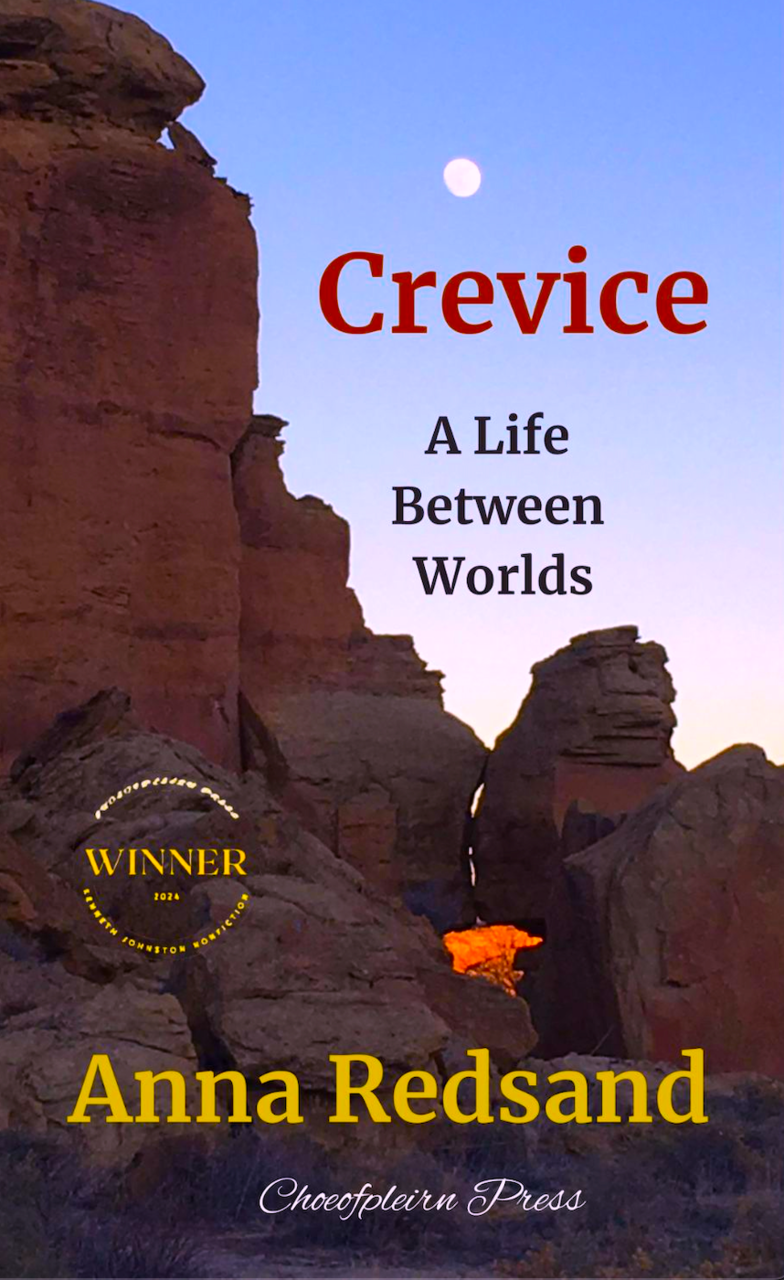
In her collection of essays, Crevice, Anna Redsand explores her experience growing up as the daughter of White missionaries among the Diné, the self-given name for the Navajo people. The book, organized into three sections, covers her early life, her search for an authentic self, and how living across two cultures shaped her. The first section explores the author’s transition from childhood to adulthood in the context of her relationship with the Diné community. The second section focuses on the author’s identity and the interactions with the people around her that helped to mold her unique self. The third and final section draws conclusions regarding how we can understand Diné culture within society as a whole.
Through recounting her experiences, Redsand explores themes such as loss of language, Christianity, White guilt, racism, and reconciliation. The idea that ultimately ties these threads together is her feeling of being “in between.” In her words, “I am not Diné – that much is obvious in so many ways. Nor am I mainstream American, whatever that is. I am someone else, someone In Between, having an identity of my own.” As she comes to terms with her identity as neither White nor Diné, she creates a welcoming space for others who may also feel caught between cultures to explore their own place in the world.
In a face-to-face interview with The Linden Review, Anna Redsand discussed her writing process, being a Third Culture Kid, her current travels, and more.
Julia Schrock & Jackson Kuhlmann: Crevice focuses a lot on your family and how you felt about their actions. For example, you write about your parents’ missionary work. In the essay, “In the Girls’ Room,” you say, “My father was not a saint in the conventional meaning of the word.” Did you anticipate that any of your extended family members (or even close friends) would have a strong reaction to what you wrote about your parents? Did this sway your decision about what made it into the memoir?
Anna Redsand: I didn't think about it so much when I was writing it, which I think is often the case. The only thing that I was really concerned about with that essay was my youngest brother. He had a very different experience of my mother than I did. He's 15 years younger than I am, so he didn't know many of the things that I included. And as I said [in the book], she mellowed as she got older, and she didn't have as many kids to be responsible for. That was a stressful life in a lot of ways for her. I have not especially wanted him to read the book, partly because of that, and because there have been some tensions between him and me. He’s fairly homophobic, so that's been an issue.
But my other brother, who's next to me in age, took the trip to Teec Nos Pos with me, in the first essay. And we're quite close. When he read it, he said, “You're mean.” And he was referring specifically to “In the Girls’ Room” when he said it. And I said, “You know, that's my story. And that's what I tried to tell.” Whenever you write a memoir, it's your story, it's not anybody else's story, and it's your perspective.
JS/JK: The book is formatted into three distinct topical sections rather than organized temporally as a lot of nonfiction tends to be. What was your thought process behind that decision? How do you think this format adds to the experience of the reader?
AR: Well, that's an interesting question, because of course, it's hard to know how a reader experiences it. I tend to write thematically, generally. My other memoir, To Drink from the Silver Cup, was also more thematic than chronological. I have to figure out the organization before I can write, in some way. It doesn't mean it won't change, but it's always a process. Part of my choice to write that way is just that that's how I think and how I like to write. It is a little bit chronological in that the very first essay starts when I'm four years old, but it doesn't stay there. Each essay also touches on my adult life.
JS/JK: Some scenes from your life appear in the book more than once, such as when you’re criticized as a child by another child for using Diné bizaad (the Navajo language). Do these scenes reveal a greater narrative thread? What is the importance of these scenes appearing in more than one section?
AR: The one you mentioned just now is about me being, I would say, vilified, by one of the other White missionary kids who had never actually lived on the reservation. That main mission where I went to boarding school is just adjacent to the reservation. And there are Diné people surrounding it. But the kids who grew up there never actually lived on the reservation, and to me, that's an important distinction because they didn't speak Dummitawry English, which is why I got vilified. Language is really important to me, and I've been trained as a linguist; of course, language is important when you're a writer. I use language a lot in these essays to explore intercultural relationships and contact. It exemplifies growing up in a crevice or living my life in a crevice between these two cultures. And the stories that repeat are ones that exemplify the alienation and also the connection with both of those cultures.
There's one story that is included three times, I think, in three different essays. And it's about the time when I'm sitting outside with a colleague, where we've been training bilingual teachers during the day. We're sitting there, and I say, “I kind of hide what I know about the Diné culture when I'm with other Diné people because I don't want them to think I think I know it all.” And she said immediately without hesitation, “You have an identity crisis, just like us.” And what she meant by “us” was college-educated Diné. That incident felt like a gift––being seen. I felt really seen by her. And then it touches on certain concepts that I keep on struggling with throughout life, really, and throughout the book. Sometimes when something is repeated, it's because, first of all, these are stand-alone essays, and secondly, it's because it's a key event in my thought process.
JS/JK: The voice in one essay is especially significant, coming across as conversational, compelling, and reflective. It also shifts in some sections when it changes to verse. How did you determine which voice was right for the piece? How did you decide in which section verse would be more effective than prose?
AR: That's the essay called “Border Town,” and I was thinking, “Oh, I want to try something experimental.” It wasn't necessarily that I thought that was the right voice for the topic, but I just wanted to do it. But it did lend itself to where I describe what that town was like compared to growing up on the reservation. I describe squares and triangles because the houses are squares and triangles instead of circles, and those kinds of things. It just seemed like it fit pretty well.
I never thought of this before, but this is one of the things that I love about not just writing, but any form of art, where things happen that you're not conscious of. And you look at it later and you go, “Oh, well, that was really cool.” That fits with “Border Town” in a way, because there's the border, there's the prose and poetry, and there are borders between those, and that became sort of a metaphor for “Border Town.”
JS/JK: We learned that you enjoy road-tripping around the country. There’s also a large component of this memoir that involves traveling, not just to new places, but places that you’ve already been and that have left an impression. Can you tell us a bit about what that experience has been like? What have you learned from your journeys that made it into this memoir and into your writing in general?
AR: Oh, that's a big question. I'm trying to think of one of the lengthy road trips that I took after I wrote my previous memoir. I did a DIY tour. I bought a van, and I outfitted it with what I needed. I lived on the road, basically, but I also spent time with friends. On that tour I went to seventeen different states and one Canadian province and I can't even remember how many cities, but the reason I could do it is that I've moved many times in my life. That's another aspect of my nomadism. I've moved seventy-two times in my life, not counting college summers. And that's sometimes a characteristic of Third Culture Kids, adults who grew up in a different culture from their parents' culture; they are restless, and restlessness is about trying to figure out where you belong and how.
Honestly, it's been very hard for me to settle. It's hard for me to settle where I am now. I still would like to live in a van on the road. And I still might, but I have grandchildren now where I'm living, so it's harder to. I've lived in Denmark, Southern Sweden, New Zealand, and I visited several countries, including Cambodia. I worked in a Cambodian Refugee Agency in Oakland at one time, and the trip to Cambodia was kind of a segue from that.
JS/JK: The ending section takes a noticeable sociological turn, bringing up themes such as loss of language, White guilt, and cultural erasure in general. Do the conclusions drawn indicate a call to action for the audience, or are they more meant for you to come to terms with your own complex identity?
AR: One of my audiences is other Third Culture Kids and other Missionary Kids. And I haven't entirely figured out how to tap into them with this book. I feel like a lot of the things that have been written about Third Culture Kids talk about the hardships of being sort of unrooted and often having to go to boarding school, things like that. They also talk about the strengths that we have, the resilience that we develop, but they don't deal with the privilege very often. There are a few books coming out now that deal with the privilege that most Third Culture Kids have because we're guests in that culture, and we're often part of more dominant cultures. We're viewed differently from those who live there.
In the chapter about boarding school, I write about how I got special treatment from the adults when I was in boarding school because I am White. I want other Third Culture Kids and Missionary Kids to be more aware of that aspect.
One of the questions I was asked when I was doing a reading recently was, “Was being a Third Culture Kid a blessing or a curse?” I said I would never say it was a curse. It was hard sometimes, and in my acknowledgments, I talk about how much I value all of it because it's made me who I am. There can be a sort of tendency among Third Culture Kids to say how hard we had it, or how hard it is now because we can't be part of that culture permanently, and we miss it. It's not very often addressed, the issue of privilege and what kind of responsibility comes with having received the gifts of that other culture. I think there's a responsibility. The essay called “The Obligation” is very much about that. What are we obligated to do? Do we have an obligation?
One of my cousins, when she read the last essay, said, “Oh, you were just laden with guilt.” And I thought, “No, I don't think of it that way.” I think, "Yes, there's maybe some guilt, but it's more like I see.” One of the points I make in the book is that when you live between cultures, you see things that people on either side don't see. You see both sides, and some of my friends have said the same thing to me. I don't see it as guilt. I see it more as having a clear-eyed vision of what is going on. When you see that, you have an obligation, but you also need to just be able to be a friend, just an ordinary person with whoever you're with. That's been a journey for me to be able to do that, and I do see it in my writing.
I often hear, “Oh, I really love Native Americans, or I really love Indians, or I really love that culture, I really am drawn to it.” I want people who say those things to see, not romanticize, and to see clearly. That's just any reader in general, but then also I really want people who are in the Third Culture Community to see some of the things that they maybe haven't seen or to think about some of the things they haven't thought about, to think about their own privilege and to realize that they received an incredible gift, and a lot of them do realize that, but they don't seem to take it to the next step. There's a little bit of missionary zeal in me, I guess, of wanting people to step up.
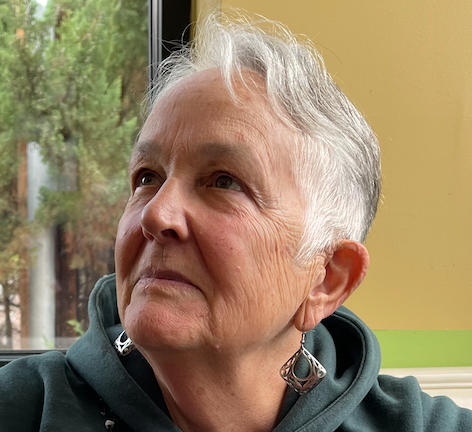
Anna Redsand writes from her lived experience as a White woman who grew up and worked between postcolonial Diné (Navajo) and White cultures. Through stories and reflection, she explores bicultural belonging and identity, the role of language in identity, and the effects of colonization. She identifies as a Third Culture Kid (TCK) and a cisgender lesbian. Other books include a spiritual memoir, To Drink from the Silver Cup, and Viktor Frankl: A Life Worth Living, a biography of Holocaust survivor and author of Man's Search for Meaning. She lives in Iowa.
Julia Schrock (she/her) is a senior at University of Nebraska-Omaha majoring in English with a concentration in Creative Nonfiction, and double minoring in Screenwriting and Sociology. She is an assistant editor for The Linden Review and her work has been featured in UNO’s student newspaper, The Gateway.
Jackson Kuhlmann (he/him) is an undergraduate senior at the University of Nebraska-Omaha who has a major in Creative Writing, with concentrations in fiction and poetry. He has minors in Philosophy and Sociology which help to inform and inspire his work. His work has been featured in 13th Floor Magazine. He was a staff member of 13th Floor Magazine and is currently a staff member of The Linden Review. He plans to attend graduate school to further study writing.