
Swim
Emily Siebert
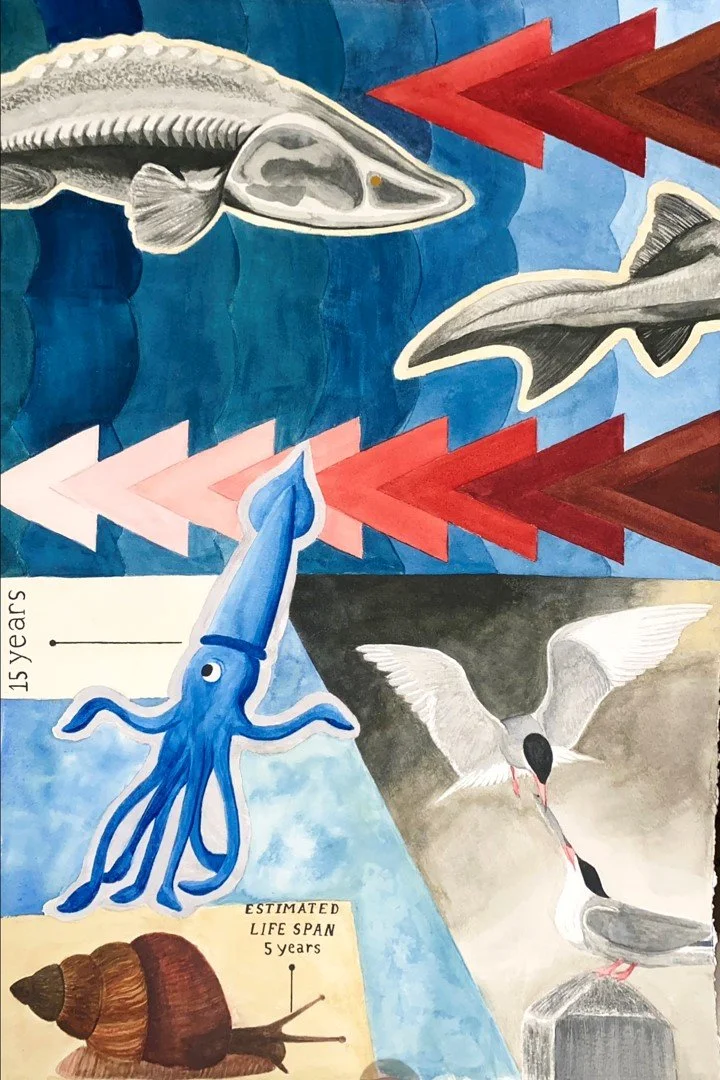
Soren Cordwin, Motion of the Ocean, 2025. Watercolor, 15” x 22.5”
During my first Multiple Sclerosis flare-up, I sensed cold river-rock-grit sloshing and fishhooks scraping inside my left leg, which I could not lift, and numbness in that part of me that only doctors and lovers have seen.
I wanted to walk again, and for you not to have to take care of me in my late thirties the way my parents and I took care of my grandfather, so I swam for you and me. You’d never learned how, so I swam alone.
My torso felt like a tombstone, but I took baby steps in the pool, and after months, swam to the point where I could feel my leg and other parts of myself again, in a good way. I swam so I could walk and do other things.
You’d grown tired. You no longer wanted to take walks with me. You no longer wanted to do other things with me.
So I found a fling who took me to the beach one day, where he sat and watched me get knocked around by cold, choppy waves, between messaging his girlfriend, who lived far across the ocean. I recalled how you’d always stood watch on shore, motioning me inland when you saw me drifting too far.
A friend told me that you are my safe harbor, and that the fling was a punctured flotation device.
After nine months of the stillborn affair, I confessed, and you said you just wanted me to be okay, that I was still the loyalest person you’ve ever known.
Sometimes when I swam laps, I thought, If I reach the wall before the old swimmer next to me, I’ll get what I want. Sometimes that was him. Sometimes it was you. Sometimes it was an imaginary man whose features and depth of love were indefinable.
While I swam, I imagined different men, at different times, standing in the second-floor window frame, looking down on me in my bathing suit, wanting every part of me.
Years later, my father had a hip operation, and one night, while I was helping my mother remobilize him in my childhood home, you walked out of ours and into another woman’s bedroom.
You confessed. I cursed you, then admitted that a love for you still thrashed inside me. There might still be time for us, or a different us, we agreed.
The day after, I watched a woman floating in the lane next to me. I envied her youth, her buoyancy, and what I imagined to be her ability to meditate. I’ve never been good at floating. My feet tend to sink, and that day, I thought the weight of my heart would anchor me to the pool floor. Then I thought about your water-blue eyes, and about fetuses – how they float in a womb. And I swam.
Emily Marie Seibert is an Associate Professor of Humanities at Mercy University in New York. She cares about media literacy, saving stray cats, and helping people tell their stories. Her essays have appeared in december magazine, X-Ray, The Fourth River, Palisades Review, and South Dakota Review.