
Opening
Rachel Silver
—for K.
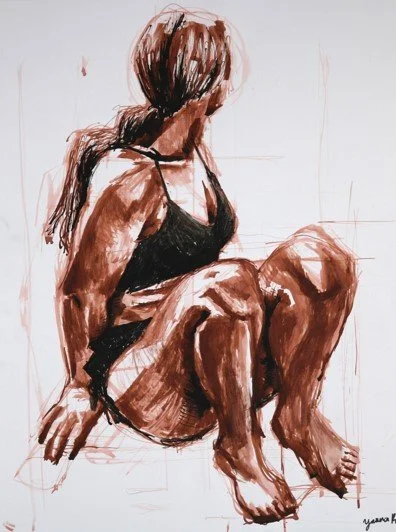
Yazmin Ratzlaff, Don’t Look, 2026. Sepia and India ink on Bristol paper, 24” x 19”
On the table, face in the hole, K’s hand on my spine, she tells me it’s stiff as a board, can you feel that? Through my clothes, she digs into a deep knot near my shoulder blade, and another, then moves into my armpit with her thumb for subscapular release because the angle is better this way. She asks me to pull my shoulder blade down and then lift my arms, lower my arms and then release my shoulder blades—the work, she says, of dissociating my shoulder blade from my shoulder joint. I do this eight times, her hand gentle on my back, to make sure I’m using the right muscles. After, she teaches me a new exercise to do at home and tells me I’m not a bother; I can reach out to her whenever I need.
*
Progress Note
M25.512: Pain in left shoulder
Hypomobile thoracic spine most notable mid t-spine
*
Seven months earlier, during a rare late March snow day, I slipped from a play structure at the local school playground, following my friend’s six-year-old in the snow, in our clunky boots. I followed her because she was fast and climbing before I could even say to her, no, not safe. It was slippery, and I didn’t want to fall, so I grabbed the metal frame and in grabbing slipped and fell off, my whole bodyweight tearing tendons, pulling muscles, my arm ripped from my body, it seemed. Somehow, I didn’t scream. I told myself I couldn’t pass out, not while watching another person’s child. I sat down in the snow, said calmly, I hurt my arm; I need to sit down, and then I’m going to take you home. I walked her back to her house, nauseated with pain. At home, I sat in the recliner and iced my arm. When I was able to get in to see my primary care doctor, she gave me a referral for physical therapy. I didn’t want to try PT without an MRI, and I couldn’t get the MRI until the sports medicine clinic ordered an x-ray. By the time I had the MRI, by the time I could get in to see the physical therapist, who turned out to be K, my arm had been injured for more than eight weeks.
*
Care Plan
The patient has been referred to P.T. with a diagnosis of L shoulder pain post fall. The patient would benefit from skilled treatment to address the goals listed. Potential contributing factors to the patient's current condition include MRI results; age. Patient was informed of the results of the evaluation, agreed with proposed treatment plan, and consented to further participation in PT treatment. Patient demonstrates good rehab potential.
*
It hurt when I moved hurt when I put on deodorant hurt when I toweled off hurt when I pulled my shirt over my head hurt when I took it off hurt when I went to get a cup from the cabinet hurt when I closed the door to the car hurt when I pulled down my pants to pee hurt during dance class hurt when I turned around to try to back the car out of the driveway hurt when I slept on it hurt all the time so I kept my arm close to my side for two months like I was my own sling—guarding, K called how I carried myself—until finally I lay on the exam table and she held my arm against her hip, said, relax, just let me have it, and rocked my arm so gently, I started to cry. What’s going on? she asked. She wasn’t hurting me. I wasn’t sad. She said something like, it’s a big deal when you are faced with surgery, when your body doesn’t do what you want it to do. And yes, for sure she was right, but I wasn’t thinking anything, just experiencing my body being held by her body, the weight of my pain in someone else’s hands.
*
Therapy Problem List
1 L shoulder pain
2 L shoulder limited range of motion
3 L shoulder weakness
4 Abnormal posture
5 Soft tissue dysfunction
6 Needs comprehensive home program to address current condition
*
That first day of PT, K had asked me what my goals were. I just wanted to move my arm without pain. The intake questionnaire she gave me brought into sharp relief the contours of my disability. Almost every daily activity presented significant challenges: I had trouble showering and getting dressed, reaching items from the refrigerator and high shelves, washing a heavy pot, writing on the whiteboard in my university classroom, putting on a seatbelt and closing the car door, typing emails on my laptop. Even sitting still, it ached. I rested my arm on a pillow on my lap. I could not imagine living indefinitely in this condition, nor could I imagine surgery and recovery as a single mom. Later, when I thought about it, my goals were oddly specific: putting on deodorant without pain, driving the car without pain, holding my arm in second position during ballet without pain. I told K that my weekly dance class was the one thing I did for fun; I couldn’t fathom not doing it again. Mostly I wanted to go back to what it felt like to inhabit my body the split second before I fell, before it was changed.
*
Progress Note
Continues to have difficulty with GH vs scapular dissociation and isolation of lower trap. Improved following cuing. Improved mobility of T spine noted with manual interventions, however still hypomobile. Added in open books to address rotational mobility. Added wall slides with band with emphasis on elbows in/parallel forearms to isolate serratus anterior—significant challenge noted. Overall, pt tolerated treatment well. Good progress with continued mobility, neuromuscular, and strength limitations.
*
Monday at 3:00 becomes my favorite time of the week. The appointments follow a predictable pattern. I read a book while I wait for K, who always runs five minutes late. She asks me to show her how my arm is moving, testing to see what it looks like raised, how far it can go behind my back and out to the side. I put my hair in a messy bun. She instructs me to lie on the table face down while she presses hard against the stuck spots in back and then places my shoulder blade between her hands trying to get it to move back into the correct position. She rubs the small muscles beside my left breast, willing them to soften. Sometimes she works on my neck and the base of my skull; she can tell from the way I hold myself what needs the most attention. It’s all connected, she explains. Then she demonstrates a new exercise to practice at home, watches me try, corrects me, asks me what my questions are. Over many sessions, we learn each other’s languages; she explains my exercises in metaphor. We sit facing each other; she watches me while I fix my hair at the end of a session. I don’t think anyone has ever watched me this intently. At home on my laptop, I read her progress notes in my chart, decode the acronyms she uses. I read what she sees in me, the way my body feels to her.
*
After one appointment, the space between my shoulder blades feeling more open than it has in months, I find myself crying for no obvious reason in the elevator, on the car ride home. On the internet, I research the connection between shoulder pain and emotional pain. Metaphorically, shoulder pain is linked to overwhelming responsibility, feeling the weight of the world, being closed off emotionally, the shoulders rounded inward. Thoracic pain is linked to broken heart, to sadness. Something in me has cracked open in her hands.
*
I didn’t cry when I fell, didn’t cry when I slammed the car door and pain reverberated through my body, didn’t cry when I tried and failed to pull a shirt over my head, didn’t cry when I went to ballet and couldn’t hold my arm higher than my hip, didn’t cry when I lugged my suitcase through the airport for a work trip, slipped my arm through the hole of my backpack, couldn’t manage to put my coat on or take it off. I didn’t cry until suddenly I did, and then I couldn’t stop.
*
Progress Note
The patient received manual therapy consisting of soft tissue manipulation to suboccs as well as L scalenes, upper trap, levator
Progressed home program with review of exercises to challenge scap retraction and depression with joint movement and stability. Patient demonstrated appropriate understanding and performance with good challenge.
*
An analysis of my calendar over the past seven months indicates that I have had more than thirty appointments related to this injury. I have seen my primary care physician, a physician’s assistant at the sports medicine clinic, an orthopedic surgeon. I have had an MRI, a cortisone injection, multiple massages, and twenty-five sessions of physical therapy to date. Reviewing my MRI, the surgeon said I would need surgery and then, after a second review, said I would not. When I first saw K, she was frank; she didn’t know if PT would help. She said to give it eight sessions. Almost six months in, she told me she was sure I was headed to surgery; I could barely move my arm.
*
On my calendar every day, along with class meetings and administrative work tasks, I write “shoulder ex.” I have a basket full of Thera bands in various colors: red, green, blue, the long ones with a knot in the middle that I anchor behind the door, the shorter loops for the exercises K calls “clockies” and “slidies”—cutesy names which turn hard work into something more manageable. The scap clocks ride the edge between challenge and real pain. I tell her they are so hard I’ve made an executive decision to use the red band instead of green. Even the red is hard; maybe I need yellow? The newest exercise has me lie at the edge of my bed, my injured left arm hanging off the side, pull the shoulder blades back and down, then pull back the elbow into a row. I’ve been doing upright rows for months and find them easiest of all the exercises. K says, this is harder, right?—all I did was add the weight of your own arm.
Before she earned her doctorate in physical therapy, K was a world-class athlete. But still, she seems genuinely excited about my newfound ability to hold up my own arm. Sometimes I wonder if I do my PT homework for me, or for her. For the sound of praise in her voice.
*
She reads my back like braille. Even talking to coworkers in the room, she says her hands are still paying attention. She pins and pulls, finds the spots that refer pain into the back of my head, the spot deep where my arm meets my torso, the one I can tell is keeping my arm from extending all the way to 180 degrees. Every session, she opens it more.
*
Today she has me on my right side, asks me to turn to the left, pins my hips to the table so I can’t turn from my lower back. She says I should be able to see the window on the other side of the room. I can barely turn. She adds these twists to my home program, at least ten each day.
*
Progress Note:
The patient was treated by skilled therapist for the stated duration.
See procedure documentation.
*
The last time I saw a psychologist, I told her there was stuff I couldn’t deal with; I was going to put it on a shelf, a metaphor, to deal with later. Now, my youngest child is mostly grown, almost thirteen, and all of it comes pouring out of that stuck spot in my spine. Still, I don’t want to talk about it, don’t know how to talk about it. There aren’t words, just this deep sorrow that rushes out when I twist on the floor, this practice K calls an “open book.” Every time I practice, I cry.
*
Held between my shoulders are twenty years of single parenting, infertility, pregnancy loss, the war in Gaza, the war in Ukraine, terror about the upcoming presidential election, always needing to do everything on my own.
*
Care Plan
Return to previous, unable to progress today due to minor setback: Continue Manual—particularly effective for pt and something she cannot do on her own.
*
If I can help you, she says, I will.
*
While she manipulates my spine, K asks about the kids, says she likes my sweater, it’s so soft, how is work going, her four-year-old wants to go trick-or-treating as a pirate. It is small talk, mostly filling the time, but I like her, I really do, and I wonder if we’d met in another context if we could be friends. Today she is giddy. She’s been stuck in meetings all day; her new job has her overseeing four different departments, and she says getting back to the clinic to work with me is the highlight of her week. She walks fast, turns quickly; I would recognize her gait anywhere. When she asks how it’s going, I want to tell her my favorite literary device is synecdoche, part for the whole, both the shoulder and me tired and cranky but also so glad to be here. Ooh, it is angry, she says, when she feels the muscles at the base of my shoulder blade; it needs to be calmed down. The whole session she turns me from back to belly to side to back, a dance between her body and my body. At one point I’m on my side, a pillow between us so she can put her knee up on the table. Her back hurts, she says, and she doesn’t want to stick her knee in me. If I open my eyes all I see is her thigh in the pants she wears that are halfway between dressy and athletic gear. When we’re done, she instructs me to sit up slowly and asks how I’m feeling, and I say, like jello, and she’s pleased with herself, with me, my body soft and pliable. Usually after I see K my body is agitated and I don’t sleep well, but this time I do so deeply; when I wake, that stuck spot near my shoulder blade is gone for the first time in months.
*
Progress Note
Manual interventions have been very effective for this patient, as have weekly updates to her home program which she is very diligent in then following. However, she continues to have functional deficits which are limiting her daily activities such as putting away heavier objects on high shelves, stability in weight-bearing positions, or wearing her backpack (which she has to do for work). She would benefit from continued PT 1x/week for 6 weeks (therapeutic ex, neuromuscular re-education, manual, self-care) to maximize functional independence for improved quality of life.
*
I read her notes in my chart, and they feel like love notes: I have been listened to and seen. I want to write back to her, tell her she has become the voice in my head when I’m at ballet class and trying to hold my arm out to the side, or sitting in a meeting. I want to send her an email and ask how her week has been. What shoes she ended up wearing the day she needed to wear a suit. If her toddler is letting her sleep. I wonder what her morning looks like, getting children into car seats and off to day care. I haven’t asked, but I bet she’s a person who wakes up early to run. I wonder if when I have reached what she calls my “functional plateau,” we could possibly be friends. But for now, I don’t even know her children’s names or the parts of her she keeps hidden, what it felt like to win a world championship, what happened when she retired from professional sports. I recognize this feeling, like being woken up after a long sleep, something resembling a crush.
*
Progress Note
Patient has made good progress overall with PT, particularly in last month since re-focus on thoracic mobility and lower trap/scap stability. She continues to have deficits in these areas which will benefit from continued skilled PT. She also continues to make gains each week, indicating that she has not reached her functional plateau.
*
I think about K when I practice my exercises. I think about K when I put on deodorant. I think about K when I sit at my desk in a Zoom meeting (sit up straight, pull your shoulder blades back and down). I think about K when I pull my arm through the straps of my backpack. She tells me to check in with her over email, and I do. She sends me back short notes with smiley face emojis. She tells me her children’s names. She asks my insurance company for more time. It is granted. Each week my shoulder is stronger, my back more open. I come closer to meeting the goals we have set together. I go to ballet class and cry now because I can move my arm. I am so grateful, but I can’t imagine never seeing her again.
*
Goals assessment:
Pain at worst 5/10 with certain movements. – Progressing.
Left shoulder ROM—Progressing.
Left shoulder strength—mostly met.
Able to tuck shirt in—GOAL MET
20 lb object on high shelf—progressing.
*
Honey, my young friend said, you are falling in love with her.
I started to think of the Venn diagram of my feelings and desires. I wanted to know K as a person who existed outside the clinic. I wanted, perhaps, after all these years of single life, to want someone romantically, or at least more intimately. I wanted someone to touch me. I wanted someone to share the burdens of my life. I was so tired of doing it all alone. The way she looked at me when I fixed my hair at the end of a session; it was deeper than pride, closer to affection. I told myself what I had with K was real, it was just finite and sponsored by my insurance company.
The heart wants what it wants, my wise friend said.
*
At home, on my yoga mat, I extend my upper back against the foam roller. I practice my open books. Today, for the first time, I make it all the way to the floor, my arms extended wide. I can’t wait to tell her.
Rachel Silver is the pseudonym of a poet, essayist, and literary scholar who works at a large research university in the Midwest. Under her real name, she has authored several books about single and queer motherhood and infertility, as well as co-edited anthologies of critical-creative scholarship.