
Interview: Sue William Silverman
By Svea Rhen

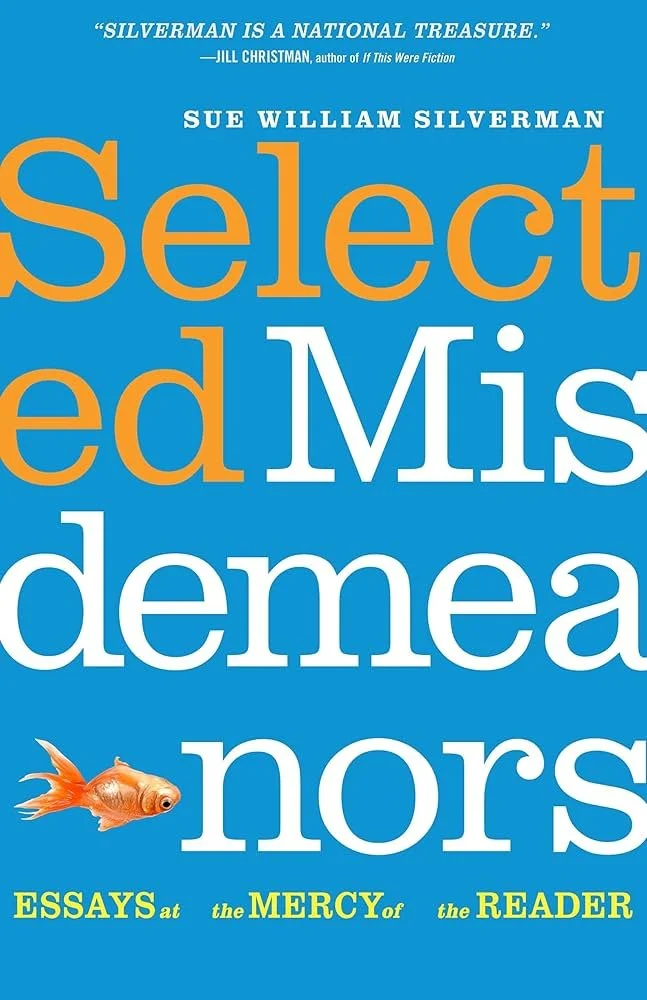
The essays in Selected Misdemeanors: Essays at the Mercy of the Reader are unapologetic word grenades lobbed into an otherwise complacent forgetfulness. Throughout the collection, Sue William Silverman focuses on pivotal, often fleeting moments that defined the course of her life, such as a fraught family vacation; an evening watching the Chippendale dancers’ extravaganza; a Pac-Man-and-whisky-fueled rumination on failed relationships; and the way melodramatic movies such as Rome Adventure shape an adolescent’s idea of love. Ranging from short to flash to micro length, these emotionally courageous writings imbue minimalist forms with maximalist emotions and an unrepentant, no-holds-barred attitude. Each action explored in this collection produces the Butterfly Effect—seemingly quotidian events rippling into emotional tsunamis.*
Svea Rhen: Many of the essays in Selected Misdemeanors: Essays at the Mercy of the Reader touch on deeply traumatic and personal matters. As a writer, I understand how difficult that can be, both to write and to publish. How did you go about protecting your heart and well-being during the writing process and after publication?
Sue William Silverman: At times, I feel enormous sadness when writing about traumatic events. But ultimately, since I write toward self-discovery, my curiosity—my need to understand and discover what any given event means—outweighs difficult subject matter. I need to better understand the metaphors and themes of my life. This drive toward self-awareness is, I guess you could say, an obsession. It helps to keep me writing.
Additionally, I constantly remind myself that I already “survived” past events. Now, as a writer, I have the opportunity to control the narrative. I own the words! It’s an empowering way to approach the material.
SR: In your pieces “Love Deferment," “The Soft Beauty of an Ordinary Life,” and many others, you delve into the complexities of the human psyche. They’re uncomfortable in the best way, urging readers to face their shadows as you do. How do you see yourself as a writer within that space, and what compels you to explore tension and sexual deviance instead of settling into the safety of the status quo?
SWS: As mentioned, I have a deep urge to better understand my life: Why did I do certain things? What do these things mean, metaphorically and thematically?
Too, the role of the artist is not to seek complacency, either for the author or for the reader. Rather, the role of the artist is to shake up the status quo—almost “force” readers to feel a sense of discomfort. It is to show the world as it is through the eyes of the artist (each artist’s own truth), not how we might wish it were. Otherwise, if we seek complacency, our writing is nothing more emotionally complex than, well, the equivalent of a Hallmark card!
I might also mention that one thing I discovered while writing these essays is that my actions weren’t “sexually deviant.” Rather, I acted out of a profound sense of alienation, loneliness, and loss. The narrator sought love; back then, sadly, she didn’t know how to find it. Discovering this—and other insights into past actions—really is motivation to write, which leads to understanding.
SR: I know for me that I often start a project with something different in mind than where I finish the project. What was your goal when you started writing Selected Misdemeanors: Essays at the Mercy of the Reader? Do you believe that you accomplished it, or did something else come to fruition in the process?
SWS: That is true for me, too! When I began Selected Misdemeanors, I thought I was only writing stand-alone pieces of flash creative nonfiction. I just kept churning out these short essays.
Then, after about a year, the essays seemingly began to “speak” to each other. They were cohering into a thematic whole. With this realization, I dug deeper into the concept of “selected misdemeanors,” and added some through-threads such as thirteen photo essays sprinkled throughout the book.
In short, what began as random essays ultimately cohered into a whole. It’s always the process of writing that leads to a final product.
SR: In an interview with Laura from laurasbooksandblogs, you stated that this book is an examination of your “sense of Home” and the “emotional misdemeanors” that compromised it. How did you decide which snapshots of your life to include—essays, letters to your future self, and photos alike?
SWS: Yes, the tension in the book is that, on the one hand, the narrator is seeking a sense of comfort, home, stability; yet, on the other hand, since she doesn’t know how to find this sense of home, the narrator engages in emotional misdemeanors (oh, such as affairs with emotionally and socially unavailable men), which prevent her from achieving comfort. These two disparate desires or compulsions are at odds with each other.
How did I decide what to include? Ah, good question. That is part of the mysterious creative process. Writing is like following a whisper. I trust this whisper to guide me through an essay, a manuscript, a book. Oh, sure, at the end of the day, after tons of revisions—and once I discover the theme of the book—some essays, which don’t fit, will be eliminated—while, at the same time, gaps will be filled. In other words, yes, creativity is a mysterious process, but it’s also a lot of hard work that takes the form of revision, revision, revision. If you “sit” with the material long enough all will be revealed. This is the process of craft becoming epiphany.
SR: The cover of this collection is eye-catching. What was the process in deciding to include Freddy the goldfish on the front and what would you consider his importance to the theme of the collection as a whole?
SWS: I’m delighted you like the cover! I do, too, and I can say this because I had nothing to do with its design! My publisher, the University of Nebraska Press, designed the cover and sent it to me. When I saw it, I fell in love with it.
Yes, there is a belly-up goldfish on the cover. This fish, Freddy, appears in “Love Deferment.” In this essay, my boyfriend, who refuses to marry me, goes off to bootcamp. I buy a goldfish for company; subsequently, I have a misguided affair with my boyfriend’s roommate (one of my misdemeanors). Not surprisingly, the roommate breaks up with me. Bereft, I forget to feed Freddy, who dies. Within the context of the essay, therefore, Freddy is a metaphor for loss of love, loneliness, the absence of comfort. In many ways, this goldfish is a metaphor for the theme of the book.
I still feel badly about Freddy to this day! Very sad.
*Introductory text from jacket copy of Selected Misdemeanors: Essays at the Mercy of the Reader.
Sue William Silverman is the author of four memoirs: How to Survive Death and Other Inconveniences, University of Nebraska Press, American Lives Series; The Pat Boone Fan Club: My Life as a White Anglo-Saxon Jew, University of Nebraska Press, American Lives Series; Because I Remember Terror, Father, I Remember You, winner of the Association of Writers and Writing Programs Award Series in Creative Nonfiction. Her memoir, Love Sick: One Woman's Journey through Sexual Addiction, was also made into a Lifetime TV Original Movie. Her craft book is Fearless Confessions: A Writer's Guide to Memoir, and her poetry collections are If the Girl Never Learns and Hieroglyphics in Neon.
Svea Rehn writes across genres with a heart rooted in creative nonfiction and fiction. Her work has appeared in 13th Floor Magazine, where she currently serves as a Fiction Editor. She also served as an Assistant Editor and Social Media Intern with The Linden Review.