
Dysphoria
Ryan Walker
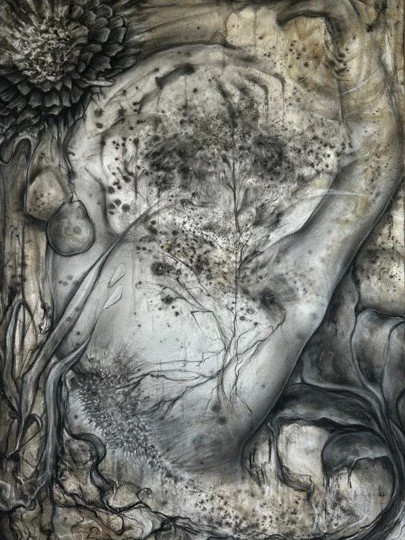
Simon Miller, The Means of Cultivation, 2025. Charcoal, ink, rust, rose petal pigment, 30” x 42”
“Einar felt lonely, and he wondered if anybody in the world would ever know him.”
― David Ebershoff, The Danish Girl
This story starts with Barbie. Her long, slender legs. Her hourglass waist and firm, plastic breasts. The hair cascading down her back. The permanent arch of her foot. Hers.
Barbie and I didn’t look anything alike, but I didn’t look like Ken either. Ken had a defined chest, whereas my ten-year-old chest was fleshy and my breasts were pointed. The shape of Ken’s stomach was muscular, and his torso was long. My stomach was slightly round and flabby, and my torso was short like my legs. I loved to rub the smooth, curved bump under Ken’s pants. I examined the form of his legs. His.
I imagined what it must take for Barbie and Ken to make a baby like women and men sometimes did. I bent the dolls into shapes. I opened their legs. I slid their bodies across one another. I made them sex, then left them in heaps when they were finished—when I was finished. Plastic bodies tangled and undressed. Theirs.
I can’t remember if my first crush was on Aladdin or Cyclops. Not the film version of Aladdin, but the doll version. His skin was darker than the Ken dolls I had, which made him look exotic to me. My penis grew hard when I played with him, and when I undressed Aladdin, it felt good to press my penis against his plastic bump. Aladdin and I played this game often.
Cyclops, or Scott Summers, was the leader of the X-Men, a cast of extraordinary individuals with sometimes secret or undiscovered powers. Scott was married to Jean Grey, but was attracted to Psylocke (Betsy Braddock), a beautiful, telepathic temptress with thigh-high boots and purple hair. In the February 1993 issue of X-Men, no. 17, Cyclops enters the bathroom in blue briefs to find Psylocke wrapped in a short towel, steam filling the space around them. The towel barely covers her round breasts and ass. When I learned what it felt like to pull the skin of my penis back and forth, it was this image of Cyclops, lingering in his blue briefs, that hovered in front of me.
As my bathroom sessions with Cyclops increased in frequency, I began to imagine I was Psylocke. It was my breasts beneath that white terry cloth towel, and my leg propped on the closed toilet seat. Cyclops would approach me and rub his penis against me, just like I had rubbed mine against Aladdin. I imagined me and Cyclops sexing until the warm sensation covered my body and made my toes curl. Each time I did this, made the sensation happen, I felt tired after. It was as if I could go to sleep and never wake up, and I liked that feeling more than anything.
Storm, or Ororo Monroe, was brown like Aladdin. She was the leader of the Uncanny X-men, a more established group of misfits with special powers. Storm was tall and beautiful like Barbie but sometimes wore her platinum hair cropped short or in a mohawk. She wore tight black bodysuits like Michelle Pfeiffer dressed as Catwoman, and she had a cape that made her look both elegant and tough. She had the body of a goddess and the strength of Cyclops. I didn’t just want to look like her. I wanted to be her.
One of Storm’s iconic outfits is a long skirt with thigh-high side slits. The slits are so high they end above the curve of her ass. When she holds a power stance, legs open, while wearing the white skirt, the panels of fabric drape in the front and back while her long, bronzed, bare legs are exposed. Storm is sex from hip to foot. She is both a temptress and a goddess. I wanted to be a temptress. I wanted to be a goddess. I needed to be Storm.
It was the summer between fourth and fifth grade. School was out, and my brother and I were home alone. I went to Dad’s closet and took one of the white undershirts from his top dresser drawer. I fetched Mom’s sewing shears from her yellow plastic sewing box. She reminded me every time she used them that I wasn’t supposed to use the scissors for anything but ribbon or fabric cutting. They were sharp enough to cut off a finger, an extremity.
I sprawled the fabric of the shirt on the carpeted floor, shaping it like I did when I rounded the Christmas Tree skirt around the base of the tree. I cut off each sleeve to square the garment, then cut the fabric on each side from the opening of the sleeve hole to the bottom hemline. I held the cut, white fabric up in front of me and examined the shape. It wasn’t as elegant as Storm’s white-paneled skirt, but it would do.
I stepped through the neck hole of the shirt and pulled the circular shape of the neck opening over my legs and around the shallow curve of my flat, fleshy butt until the fabric settled around my soft waistline. I had completed this act before, the fashioning of a skirt, tucking the sleeves inside the garment to look like pockets, and posed in front of the long mirror on the back of my door. But this skirt looked different, and, more importantly, it felt different. I stood on my toes, arched my foot as high as Barbie’s. I sort of looked like a temptress, but only from the waist down.
Under the front panel of Storm’s makeshift skirt, my penis poked against the fabric. I pulled the neckline down, slipped it over my straight, boyish hips. I stood in front of the mirror, my legs close together, arms at my side. I looked like a lumpy pencil. My head, the sharpened tip. The skirt, pooled at my feet, the eraser.
In the film version of The Danish Girl, Eddie Redmayne plays a fictionalized version of Lili Elbe, a trans woman. On the screen, Eddie stands before a mirror and tucks his penis between his legs. His pelvis is smooth. You cannot see a bump or bulge underneath the drape of his skirt. He is small, beautiful, and feminine. He is playing a part, a character, but he is playing it with his whole body. I believed him. I believed her.
In the source text, David Ebershoff describes this pivotal scene with precision. Step by step, Einar painstakingly and beautifully transforms into Lili. The gooey medical gauze and scissors are the tools, and the mirror is a portal.
Watching my own reflection, I pushed my penis down, held it between my smashed thighs. The V between my legs looked a little bit like the smooth spot between Barbie’s legs. I shifted my hips from side to side, imagining what it would look like to have a pronounced curve like she did. I leaned my chest and shoulders forward, towards the mirror, let the flesh of my breasts settle in front of me. I pushed them together, tried to round them like Barbie. How would Aladdin and I rub our penises together now? We would have to find new ways to play.
Mirror, mirror. My reflection and I stared at each other, my penis hidden from both of us. I opened my legs, let the extremity retract to its permanent place on the front of me. I needed it gone.
I bent down to pick up my mother’s sewing shears from where I left them on the floor. I slipped my right thumb and index finger through the silver handles, the metal cold and sterile. I pulled the blades apart and positioned the base of my penis where the two blades intersected. I felt the chill of the cool metal cover my body. As I stared at my reflection, my eyes burned and watered.
I breathed deeply, counted backwards from ten like they told me to when I had my tonsils removed. But I never fell into sleeping-beauty-like rest as I had in the hospital bed. I pinched the blades together, cut at the flesh where my penis met my body. The cold scissors fell from my hands to the floor, slicing the top of my foot on their way to the ground.
Hemophilia is a gene mutation carried by women, but it only presents in males. My father and I both have factor eight hemophilia. Different matriarchs, same genetic mutation. Our blood is slow to clot.
Author David Ebershoff, actor Eddie Redmayne, and The Danish Girl film director Tom Hooper, are three of the cisgender men who told a reimagined and fictionalized account of Lili Elbe’s story from 2000 to 2015. In partnership with Lambda Literary, David Ebershoff established the Lili Elbe scholarship fund for emerging transgender writers in 2017.
Lili Elbe, whose real name was Lili Ilse Elvenes, was not the first sex reassignment patient. Dora Richter is the first documented transgender woman to receive the surgery. I say their names loudly, proudly. Lili didn’t die after her second operation. She died from organ rejection after her fifth surgery, a uterus transplant.
The emasculation was unsuccessful. I had to help my mother scrub the blood out of my bedroom carpet with Dawn dish soap. A penance for my sin.
XY. There are proper ways to sharpen a knife, to sharpen shears. Precise angles. Coarse whetstone. Remove the burrs. Lubricate the blade(s). The finished product is razor sharp, but even the blade of a guillotine prefers the subject’s hair to be cut – the anterior cervical unobstructed. With the proper conditioning, a painless severance occurs at the single slice of the blade.
Ryan Walker (he/him) is a Pushcart-nominated, queer writer from Dayton, Ohio. He earned his Creative Writing MFA from EKU’s Bluegrass Writers Studio, and his work has been featured by Flights, Longridge Review, Red Noise Collective, Miracle Monocle, The Uncommon Grackle, No Tokens, and others. His hybrid form chapbook Americano has been longlisted for multiple awards. When he isn’t advocating for the Oxford comma, Ryan is exploring a town near you. Instagram: @ryan.wrote.it.